Page 1 of 1
Question 2 (a) (i) Assume that the air velocity through a wind turbine is equal to the mean of the velocity far upstream
Posted: Sun May 15, 2022 10:30 pm
by answerhappygod
- Question 2 A I Assume That The Air Velocity Through A Wind Turbine Is Equal To The Mean Of The Velocity Far Upstream 1 (107.13 KiB) Viewed 45 times
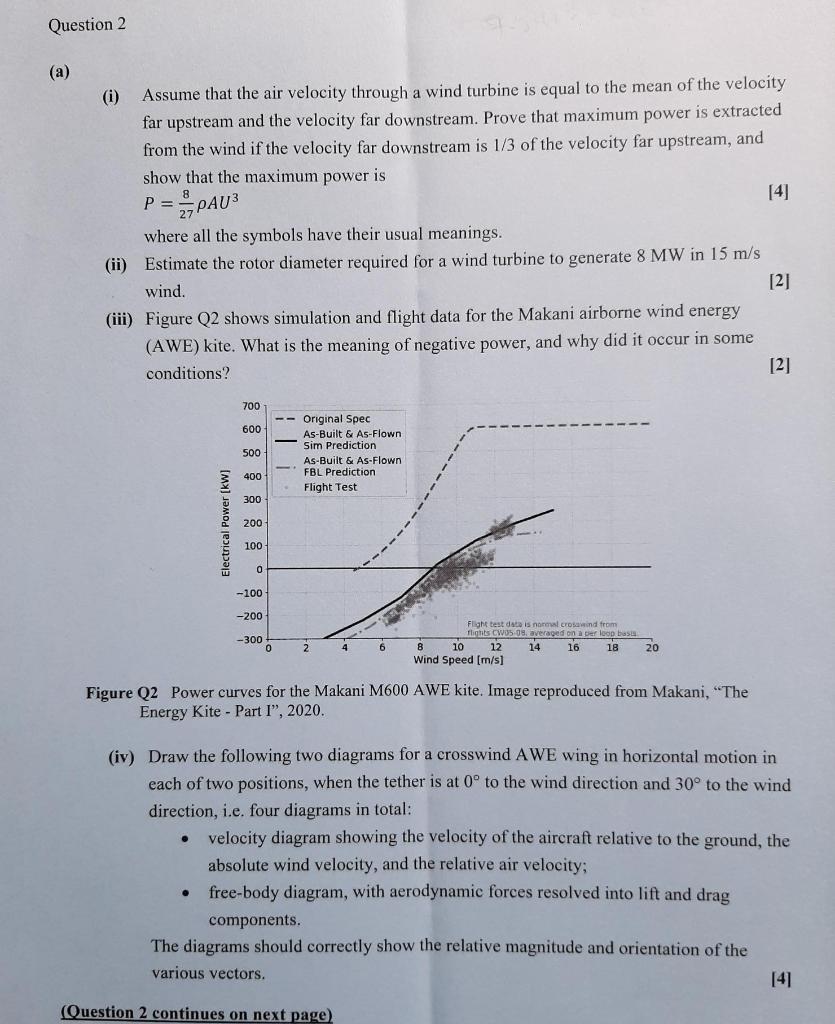
Question 2 (a) (i) Assume that the air velocity through a wind turbine is equal to the mean of the velocity far upstream and the velocity far downstream. Prove that maximum power is extracted from the wind if the velocity far downstream is 1/3 of the velocity far upstream, and show that the maximum power is P = PAU 141 where all the symbols have their usual meanings. (ii) Estimate the rotor diameter required for a wind turbine to generate 8 MW in 15 m/s wind. [2] (iii) Figure Q2 shows simulation and flight data for the Makani airborne wind energy (AWE) kite. What is the meaning of negative power, and why did it occur in some conditions? [2] 700 600 500 Original Spec As-Built & As-Flown Sim Prediction As-Built & As-Flown FBL Prediction Flight Test 400 300 Electrical Power [kW] 200 100 0 -100 -200 -300 6 Flight test data is normal croswind from Tights W05 08. averaged on a ser loop base 8 10 12 14 16 18 Wind Speed (m/s) 20 Figure Q2 Power curves for the Makani M600 AWE kite. Image reproduced from Makani, “The Energy Kite - Part 1", 2020. (iv) Draw the following two diagrams for a crosswind AWE wing in horizontal motion in each of two positions, when the tether is at 0° to the wind direction and 30° to the wind direction, i.e. four diagrams in total: • velocity diagram showing the velocity of the aircraft relative to the ground, the absolute wind velocity, and the relative air velocity; • free-body diagram, with aerodynamic forces resolved into lift and drag components. The diagrams should correctly show the relative magnitude and orientation of the various vectors. [41 (Question 2 continues on next page)
Question 2 (continued) (b) The reactor pressure vessel (RPV) of a boiling-water nuclear power plant comprises a cylinder of diameter 6 m, with hemispherical end caps, and overall length 24 m. Under normal operating conditions, the RPV is at 8 MPa, the fuel generates 1800 MW of heat, and the vessel contains 319,500 kg of water. Assume the whole internal volume is filled by water. Water enters the RPV at 55°C and leaves as saturated vapour. (i) What flow rate is required to maintain these conditions in steady state? [6] (ii) In an accident, the water flow stops. Control rods are inserted and the heating power drops to 2% of the normal level. The RPV remains sealed. How long will it take for temperature in the RPV to teach 400°C? [7]