Page 1 of 1
The international Maritime Organisation has set a target for international shipping to reduce greenhouse gas emissions b
Posted: Sun May 15, 2022 10:08 pm
by answerhappygod
- The International Maritime Organisation Has Set A Target For International Shipping To Reduce Greenhouse Gas Emissions B 1 (79.67 KiB) Viewed 42 times
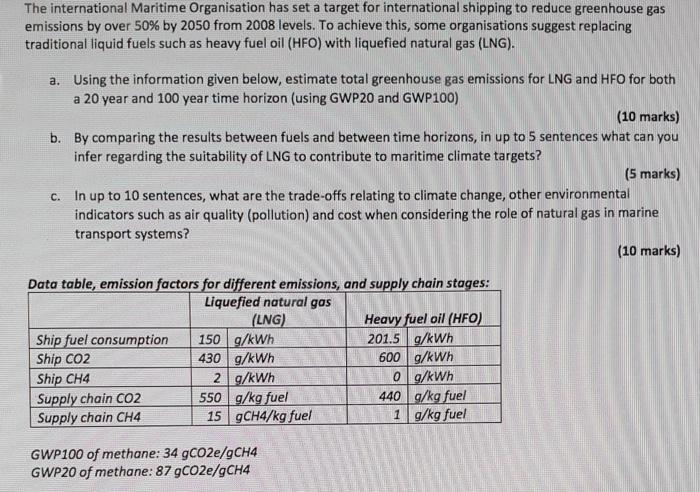
The international Maritime Organisation has set a target for international shipping to reduce greenhouse gas emissions by over 50% by 2050 from 2008 levels. To achieve this, some organisations suggest replacing traditional liquid fuels such as heavy fuel oil (HFO) with liquefied natural gas (LNG). a. Using the information given below, estimate total greenhouse gas emissions for LNG and HFO for both a 20 year and 100 year time horizon (using GWP20 and GWP100) (10 marks) b. By comparing the results between fuels and between time horizons, in up to 5 sentences what can you infer regarding the suitability of LNG to contribute to maritime climate targets? (5 marks) C. In up to 10 sentences, what are the trade-offs relating to climate change, other environmental indicators such as air quality (pollution) and cost when considering the role of natural gas in marine transport systems? (10 marks) Data table, emission factors for different emissions, and supply chain stages: Liquefied natural gas (LNG) Heavy fuel oil (HFO) Ship fuel consumption 150 g/kWh 201.5 g/kWh Ship CO2 430 g/kWh 600 g/kWh Ship CH4 2 g/kWh 0 g/kWh Supply chain CO2 550 g/kg fuel 440 g/kg fuel Supply chain CH4 15 OCH4/kg fuel 1 g/kg fuel GWP100 of methane: 34 gCO2/gCH4 GWP20 of methane: 87 gCO2e/gCH4