Page 1 of 1
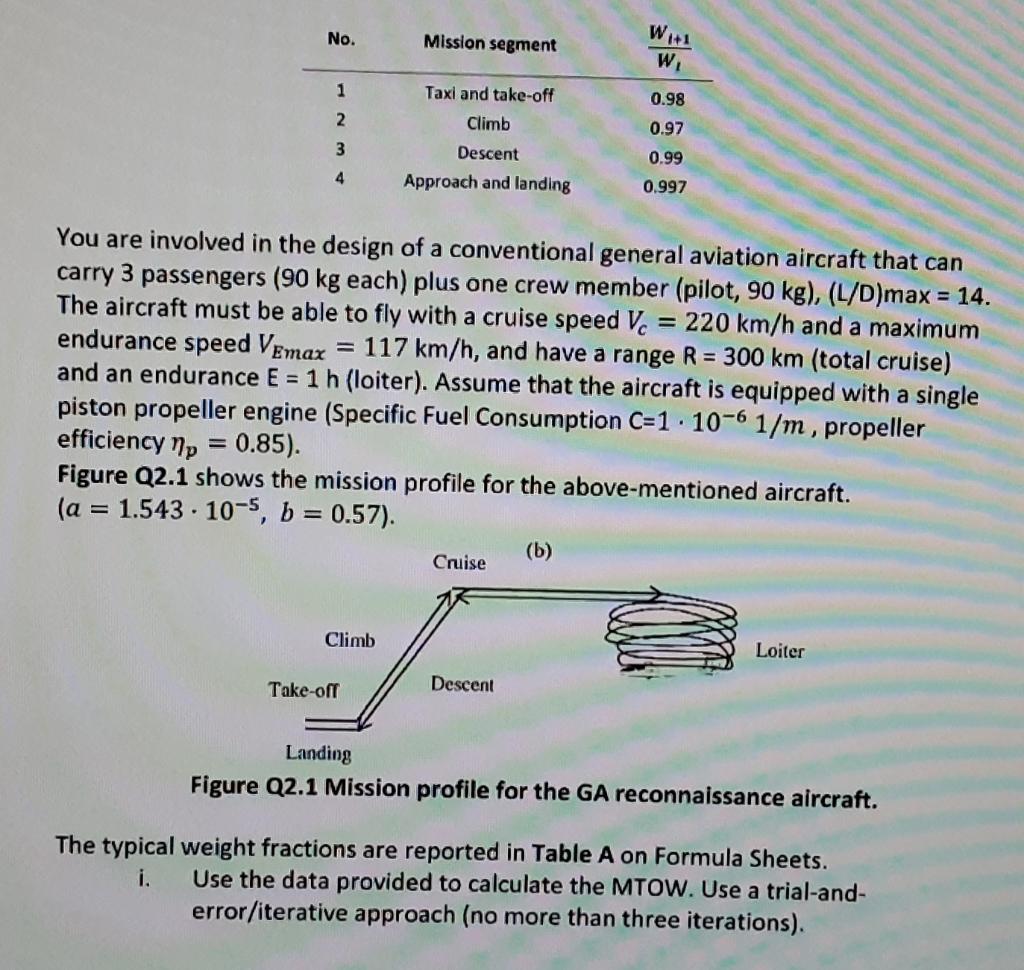
No. Mission segment W1+1 W 1 Taxi and take-off 2 Climb 0.98 0.97 0.99 3 Descent Approach and landing 4 0.997 You are inv
Posted: Sun May 15, 2022 9:04 pm
by answerhappygod
- No Mission Segment W1 1 W 1 Taxi And Take Off 2 Climb 0 98 0 97 0 99 3 Descent Approach And Landing 4 0 997 You Are Inv 1 (137.5 KiB) Viewed 50 times
No. Mission segment W1+1 W 1 Taxi and take-off 2 Climb 0.98 0.97 0.99 3 Descent Approach and landing 4 0.997 You are involved in the design of a conventional general aviation aircraft that can carry 3 passengers (90 kg each) plus one crew member (pilot, 90 kg), (L/D)max = 14. The aircraft must be able to fly with a cruise speed V = 220 km/h and a maximum endurance speed Vemax 117 km/h, and have a range R = 300 km (total cruise) and an endurance E = 1 h (loiter). Assume that the aircraft is equipped with a single piston propeller engine (Specific Fuel Consumption C=1 . 10-6 1/m , propeller efficiency np 0.85). Figure Q2.1 shows the mission profile for the above-mentioned aircraft. (a = 1.543 . 10-5, b = 0.57). (b) Cruise = . Climb Loiter Take-off Descent Landing Figure Q2.1 Mission profile for the GA reconnaissance aircraft. The typical weight fractions are reported in Table A on Formula Sheets. i. Use the data provided to calculate the MTOW. Use a trial-and- error/iterative approach (no more than three iterations).