Page 1 of 1
Question: 2 2.1 Define the instantaneous frequency, fi(t), of the constant-amplitude signal 3(t) = A cos($(t)). If the i
Posted: Sun May 15, 2022 6:17 pm
by answerhappygod
- Question 2 2 1 Define The Instantaneous Frequency Fi T Of The Constant Amplitude Signal 3 T A Cos T If The I 1 (106.46 KiB) Viewed 66 times
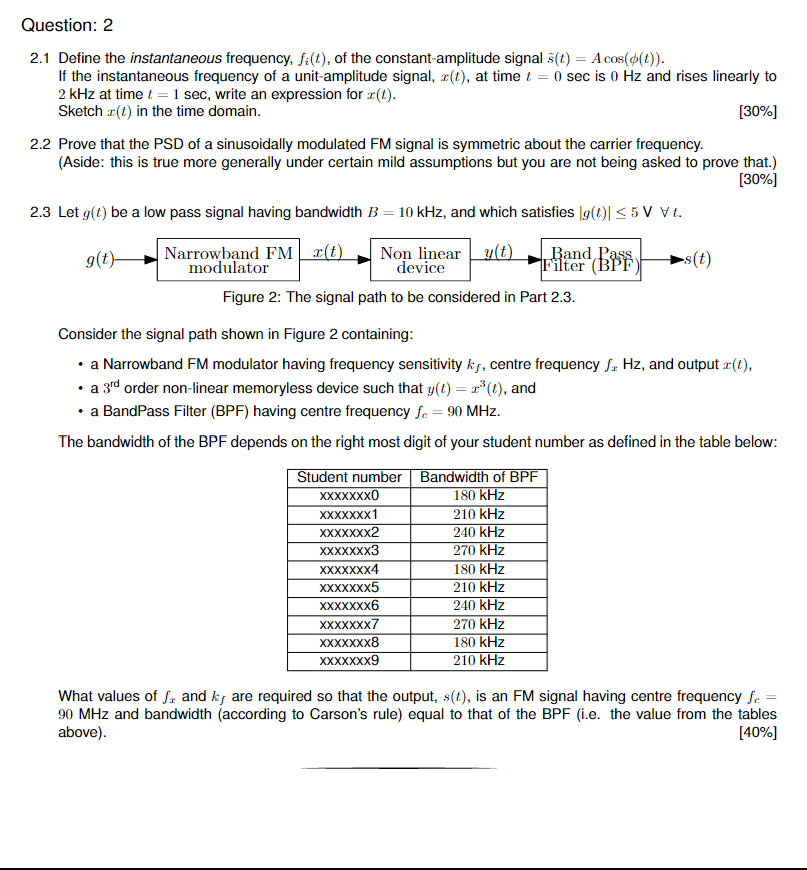
Question: 2 2.1 Define the instantaneous frequency, fi(t), of the constant-amplitude signal 3(t) = A cos($(t)). If the instantaneous frequency of a unit-amplitude signal, r(t), at time t = 0 sec is 0 Hz and rises linearly to 2 kHz at time t = 1 sec, write an expression for 2(t). Sketch e(t) in the time domain. (30%) 2.2 Prove that the PSD of a sinusoidally modulated FM signal is symmetric about the carrier frequency. (Aside: this is true more generally under certain mild assumptions but you are not being asked to prove that.) [30%] 2.3 Let g(t) be a low pass signal having bandwidth B = 10 kHz, and which satisfies g(t) < 5 V Vt. Band BHT g(t) s(t) Narrowband FM c(t) Non linear y(t) modulator device Figure 2: The signal path to be considered in Part 2.3. Consider the signal path shown in Figure 2 containing: • a Narrowband FM modulator having frequency sensitivity kf, centre frequency f. Hz, and output z(t), • a 3rd order non-linear memoryless device such that y(t)=r"(t), and • a BandPass Filter (BPF) having centre frequency fe= 90 MHz. The bandwidth of the BPF depends on the right most digit of your student number as defined in the table below: Student number Bandwidth of BPF XXXXXXXO 180 kHz XXXXXXX1 210 kHz XXXXXXX2 240 kHz XXXXXXX3 270 kHz XXXXXXX4 180 kHz XXXXXXX5 210 kHz XXXXXXX6 240 kHz XXXXXXX7 270 kHz XXXXXXX8 180 kHz XXXXXXX9 210 kHz What values of fe and k; are required so that the output, s(t), is an FM signal having centre frequency fo = 90 MHz and bandwidth (according to Carson's rule) equal to that of the BPF (i.e. the value from the tables above). [40%)