Page 1 of 1
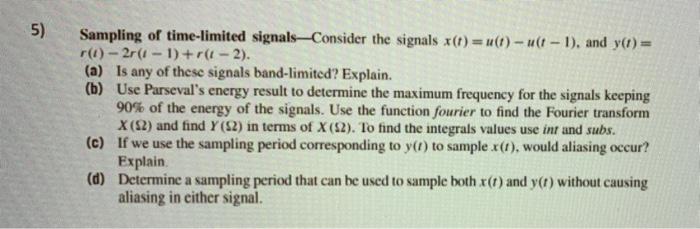
) 5) Sampling of time-limited signals Consider the signals x(t) = u(t) - (1 - 1), and y(t) = r(i) - 2r(1 - 1) +r(t - 2).
Posted: Sun May 15, 2022 4:23 pm
by answerhappygod
- 5 Sampling Of Time Limited Signals Consider The Signals X T U T 1 1 And Y T R I 2r 1 1 R T 2 1 (29.58 KiB) Viewed 50 times
) 5) Sampling of time-limited signals Consider the signals x(t) = u(t) - (1 - 1), and y(t) = r(i) - 2r(1 - 1) +r(t - 2). (a) Is any of these signals band-limited? Explain. (b) Use Parseval's energy result to determine the maximum frequency for the signals keeping 90% of the energy of the signals. Use the function fourier to find the Fourier transform X(92) and find Y (92) in terms of X(92). To find the integrals values use int and subs. (c) If we use the sampling period corresponding to y(t) to sample .x (t), would aliasing occur? Explain (d) Determine a sampling period that can be used to sample both r(t) and y(t) without causing aliasing in either signal.