Page 1 of 1
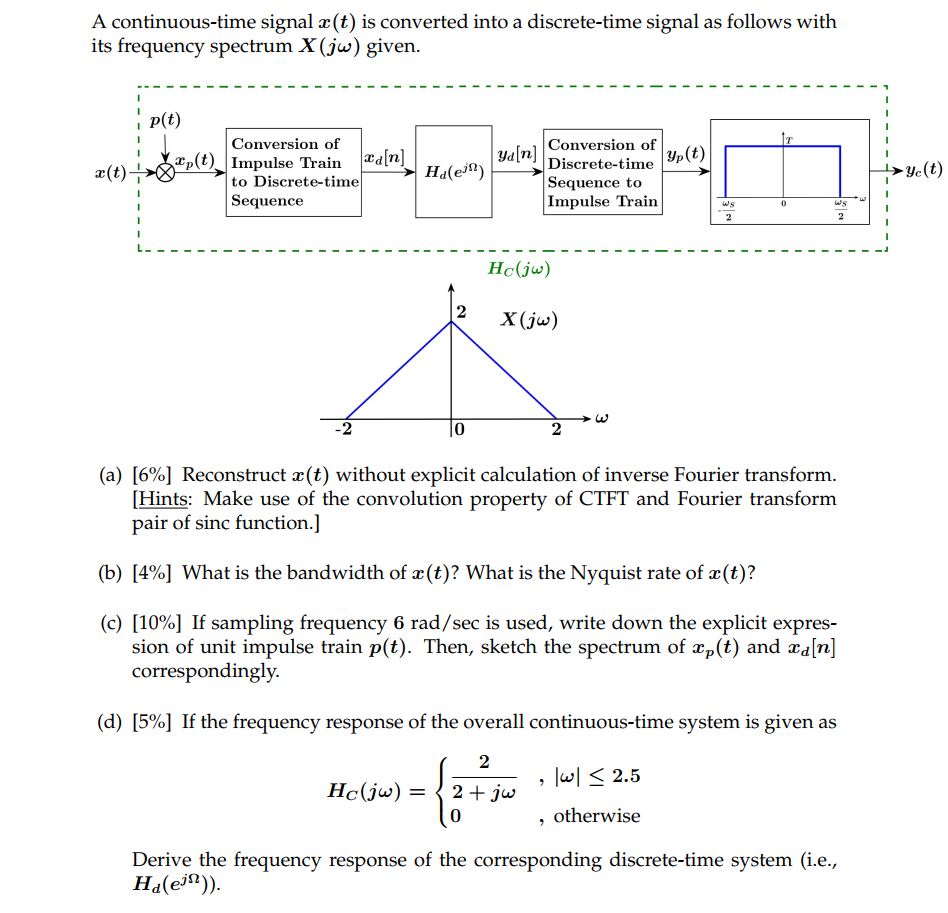
A continuous-time signal x(t) is converted into a discrete-time signal as follows with its frequency spectrum X (jw) giv
Posted: Sun May 15, 2022 2:18 pm
by answerhappygod
- A Continuous Time Signal X T Is Converted Into A Discrete Time Signal As Follows With Its Frequency Spectrum X Jw Giv 1 (191.35 KiB) Viewed 65 times
A continuous-time signal x(t) is converted into a discrete-time signal as follows with its frequency spectrum X (jw) given. p(t) Conversion of 32p(t) Impulse Train |x a[n] to Discrete-time Sequence yan] Yp(t) x(t) Hd(e) Conversion of Discrete-time Sequence to Impulse Train yc(t) ولما 0 1 1 Ws 2 Hc(jw) 2 X (jw) -2 0 2 (a) [6%] Reconstruct x(t) without explicit calculation of inverse Fourier transform. [Hints: Make use of the convolution property of CTFT and Fourier transform pair of sinc function.] (b) [4%] What is the bandwidth of x(t)? What is the Nyquist rate of x(t)? (c) (10%] If sampling frequency 6 rad/sec is used, write down the explicit expres- sion of unit impulse train p(t). Then, sketch the spectrum of xp(t) and xd[n] correspondingly. (d) [5%] If the frequency response of the overall continuous-time system is given as 2 2 + jw 0 2.5 > اس| , Hc(jw) = , otherwise Derive the frequency response of the corresponding discrete-time system (i.e., Hd(ein)).