- Consider The Following Er Diagram Which Shows Aspects Of The Business Of A Real Estate Agency As A Part Of The Assignm 1 (228.82 KiB) Viewed 52 times
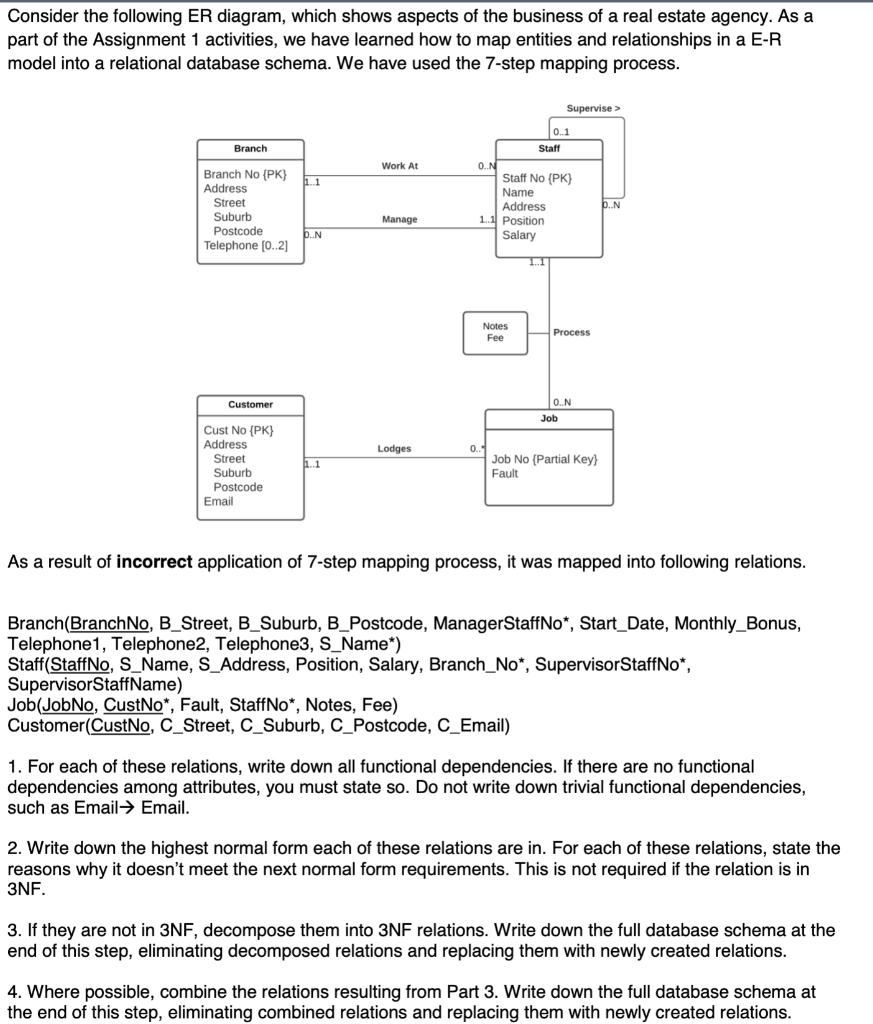
Consider the following ER diagram, which shows aspects of the business of a real estate agency. As a part of the Assignment 1 activities, we have learned how to map entities and relationships in a E-R model into a relational database schema. We have used the 7-step mapping process. Supervise > 0.1 Staff Branch Work At 1.1 ON Staff No (PK) Name Address Branch No (PK} Address Street Suburb Postcode Telephone (0..21 b..N Manage 11 Position b.N Salary 1. Notes Fee Process Customer 0..N Job Lodges Cust No (PK) Address Street Suburb Postcode 1..1 Job No {Partial Key} Fault Email As a result of incorrect application of 7-step mapping process, it was mapped into following relations. Branch(BranchNo, B_Street, B_Suburb, B_Postcode, ManagerStaffNo*, Start_Date, Monthly_Bonus, Telephone1, Telephone2, Telephone3, S_Name*) Staff (StaffNo, S_Name, S_Address, Position, Salary, Branch_No*, Supervisor StaffNo*, Supervisor StaffName) Job(JobNo, CustNo*, Fault, StaffNo*, Notes, Fee) Customer(CustNo, C_Street, C_Suburb, C_Postcode, C_Email) 1. For each of these relations, write down all functional dependencies. If there are no functional dependencies among attributes, you must state so. Do not write down trivial functional dependencies, such as Email Email. 2. Write down the highest normal form each of these relations are in. For each of these relations, state the reasons why it doesn't meet the next normal form requirements. This is not required if the relation is in 3NF. 3. If they are not in 3NF, decompose them into 3NF relations. Write down the full database schema at the end of this step, eliminating decomposed relations and replacing them with newly created relations. 4. Where possible, combine the relations resulting from Part 3. Write down the full database schema at the end of this step, eliminating combined relations and replacing them with newly created relations.
5. Write down the final relational database schema. Important: No marks are awarded to the final schema in Part 5 if you do not show the workings of decompositions in Part 3) and combining relations (in Part 4). Indicate the primary key (underlined) and foreign key(s) (with an asterisk*) in each relation.