Page 1 of 1
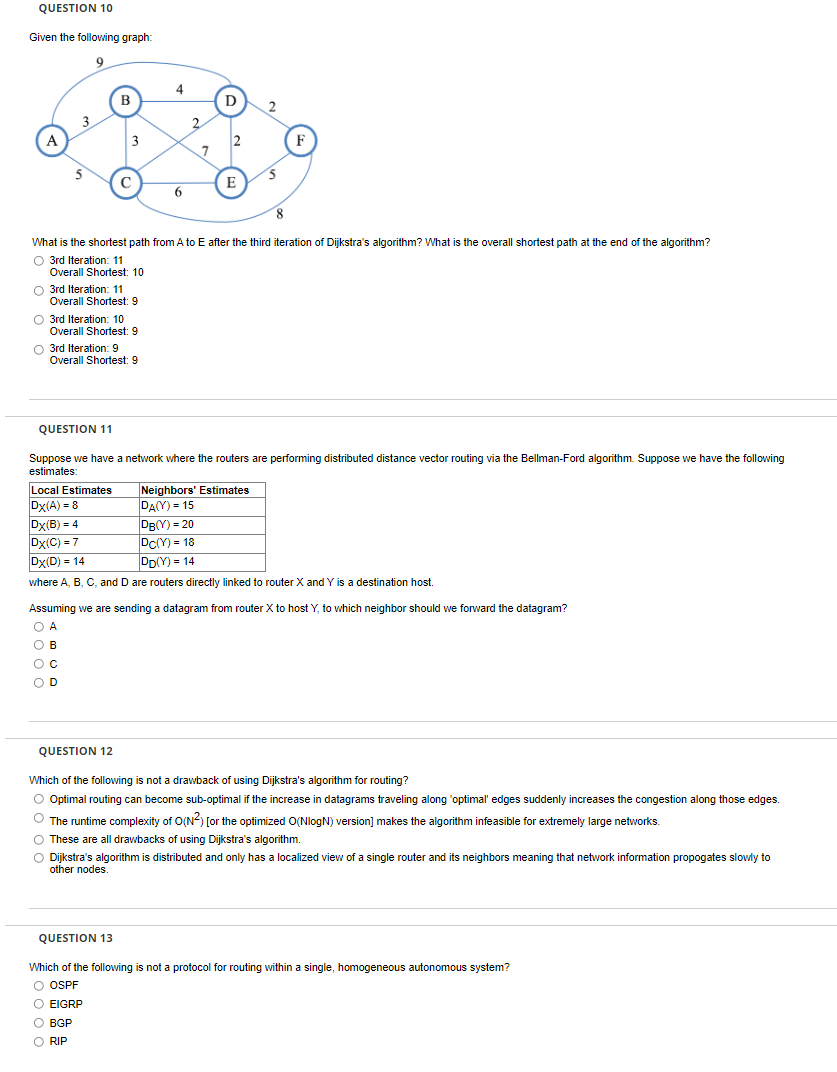
QUESTION 10 Given the following graph: 9 4 B D 2 3 2 А 3 2 F 7 5 C E 6 оооо What is the shortest path from A to E after
Posted: Sun May 15, 2022 1:00 pm
by answerhappygod
- 1 (69.58 KiB) Viewed 68 times
QUESTION 10 Given the following graph: 9 4 B D 2 3 2 А 3 2 F 7 5 C E 6 оооо What is the shortest path from A to E after the third iteration of Dijkstra's algorithm? What is the overall shortest path at the end of the algorithm? 3rd Iteration: 11 Overall Shortest: 10 3rd Iteration: 11 Overall Shortest: 9 3rd Iteration: 10 Overall Shortest: 9 3rd Iteration: 9 Overall Shortest: 9 QUESTION 11 Suppose we have a network where the routers are performing distributed distance vector routing via the Bellman-Ford algorithm. Suppose we have the following estimates Local Estimates Neighbors' Estimates Dx(A) = 8 DAY) = 15 Dx(B) = 4 DB(Y) = 20 Dx(C) = 7 Dc(Y) = 18 Dy(D) = 14 Dp(Y) = 14 where A, B, C, and D are routers directly linked to router X and Y is a destination host. Assuming we are sending a datagram from router X to host Y, to which neighbor should we forward the datagram? OA OB OC OD QUESTION 12 Which of the following is not a drawback of using Dijkstra's algorithm for routing? O Optimal routing can become sub-optimal if the increase in datagrams traveling along'optimal edges suddenly increases the congestion along those edges. The runtime complexity of O(N2) [or the optimized (NlogN) version] makes the algorithm infeasible for extremely large networks These are all drawbacks of using Dijkstra's algorithm. Dijkstra's algorithm is distributed and only has a localized view of a single router and its neighbors meaning that network information propogates slowly to other nodes. QUESTION 13 Which of the following is not a protocol for routing within a single, homogeneous autonomous system? O OSPF O EIGRP O BGP O RIP