Page 1 of 1
+ 5! + Question 6 (25 pts) Create a script file 'sine' to create a plot of sine function using exact sing function, then
Posted: Sun May 15, 2022 8:47 am
by answerhappygod
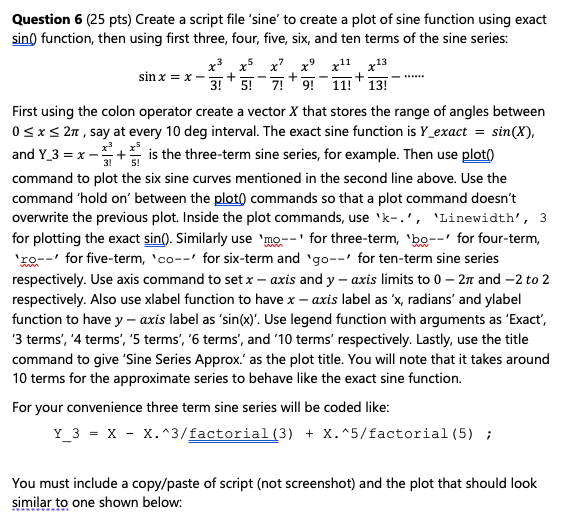
- 5 Question 6 25 Pts Create A Script File Sine To Create A Plot Of Sine Function Using Exact Sing Function Then 1 (84.45 KiB) Viewed 62 times
+ 5! + Question 6 (25 pts) Create a script file 'sine' to create a plot of sine function using exact sing function, then using first three, four, five, six, and ten terms of the sine series: x3 x5 x? x' x1 x3 sin x = x - 3! 7!" 9! 11!" 13 First using the colon operator create a vector X that stores the range of angles between OSXs21, say at every 10 deg interval. The exact sine function is Y_exact = sin(x), and Y_3 = x -+ is the three-term sine series, for example. Then use plot() command to plot the six sine curves mentioned in the second line above. Use the command 'hold on' between the plot commands so that a plot command doesn't overwrite the previous plot. Inside the plot commands, use 'k-.', 'Linewidth', 3 for plotting the exact sin(). Similarly use 'mo--' for three-term, 'bo--' for four-term, 19--' for five-term, 'co--' for six-term and 'go--' for ten-term sine series respectively. Use axis command to set x - axis and y-axis limits to 0 - 27 and 2 to 2 respectively. Also use xlabel function to have x - axis label as 'x, radians' and ylabel function to have y - axis label as 'sin(x)'. Use legend function with arguments as 'Exact', '3 terms', '4 terms', '5 terms', '6 terms', and '10 terms' respectively. Lastly, use the title command to give 'Sine Series Approx.' as the plot title. You will note that it takes around 10 terms for the approximate series to behave like the exact sine function. For your convenience three term sine series will be coded like: Y_3 = X - X.^3/factorial (3) + X. ^5/factorial (5) ; You must include a copy/paste of script (not screenshot) and the plot that should look similar to one shown below: