Page 1 of 1
True/False (Circle Tor E): 1. Tor F - Full pathnames start at the directory indicated by forward slash (/). 2. Tor F - A
Posted: Sun May 15, 2022 8:16 am
by answerhappygod
- True False Circle Tor E 1 Tor F Full Pathnames Start At The Directory Indicated By Forward Slash 2 Tor F A 1 (49.71 KiB) Viewed 56 times
- True False Circle Tor E 1 Tor F Full Pathnames Start At The Directory Indicated By Forward Slash 2 Tor F A 2 (26.88 KiB) Viewed 56 times
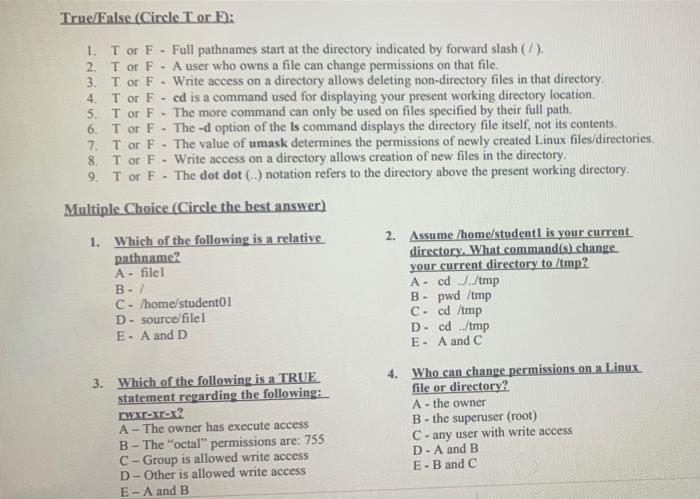
True/False (Circle Tor E): 1. Tor F - Full pathnames start at the directory indicated by forward slash (/). 2. Tor F - A user who owns a file can change permissions on that file. 3. Tor F. Write access on a directory allows deleting non-directory files in that directory 4. T or F - cd is a command used for displaying your present working directory location 5. Tor F- The more command can only be used on files specified by their full path. 6. T or F . The -d option of the is command displays the directory file itself, not its contents. 7 T or F . The value of umask determines the permissions of newly created Linux files/directories. 8. Tor F - Write access on a directory allows creation of new files in the directory 9. T or F . The dot dot (..) notation refers to the directory above the present working directory vi00 Multiple Choice (Circle the best answer) 1. Which of the following is a relative pathname? A-filet B. C- /home/student01 D- source/filel E- A and D 2. Assume /home/studenti is your current directory. What command(s) change your current directory to /tmp? A.cd ../tmp B. pwd /tmp C - cd /tmp D- cd /tmp E- A and C 3. Which of the following is a TRUE statement regarding the following: ГwХr-x-x? A - The owner has execute access B - The "octal" permissions are: 755 C - Group is allowed write access D-Other is allowed write access E- A and B 4. Who can change permissions on a Linux file or directory? A - the owner B - the superuser (root) C - any user with write access D-A and B E- and C
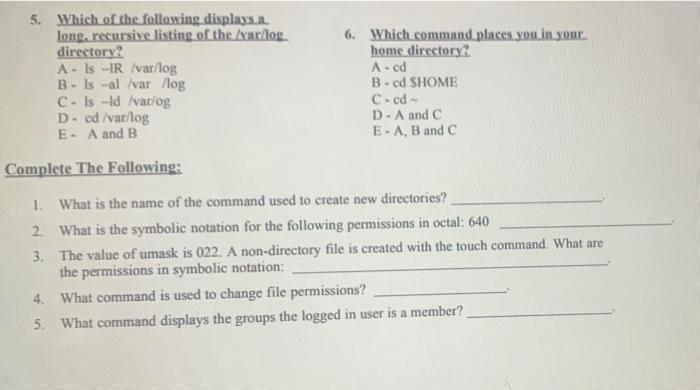
5. Which of the following displays. long. recursive listing of the yardlog directory? A - Is -IR /var/log B. Is -al /var/log C. Is-Id /var/og D. cd /var/log E- A and B 6. Which command places you in your home directory? Aed B.cd SHOME C-cd- D-A and C E-A, B and C Complete The Following: 1. What is the name of the command used to create new directories? 2. What is the symbolic notation for the following permissions in octal: 640 3. The value of umask is 022. A non-directory file is created with the touch command. What are the permissions in symbolic notation; 4. What command is used to change file permissions? 5. What command displays the groups the logged in user is a member?