- 3 30 Points Level 2 3 And 4 This Question Involves Level 4 High Language Level Level 3 Machine Language Leve 1 (42.62 KiB) Viewed 39 times
- 3 30 Points Level 2 3 And 4 This Question Involves Level 4 High Language Level Level 3 Machine Language Leve 2 (39.77 KiB) Viewed 39 times
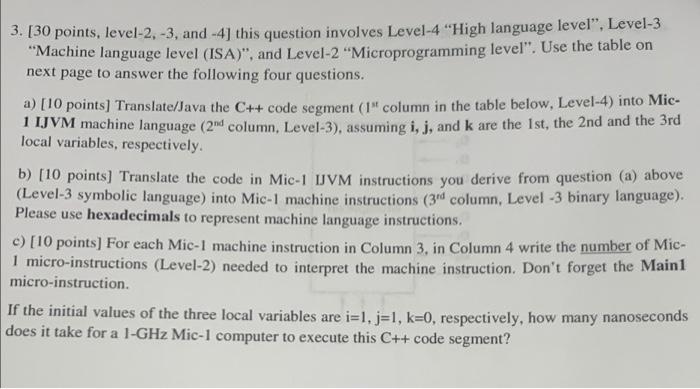
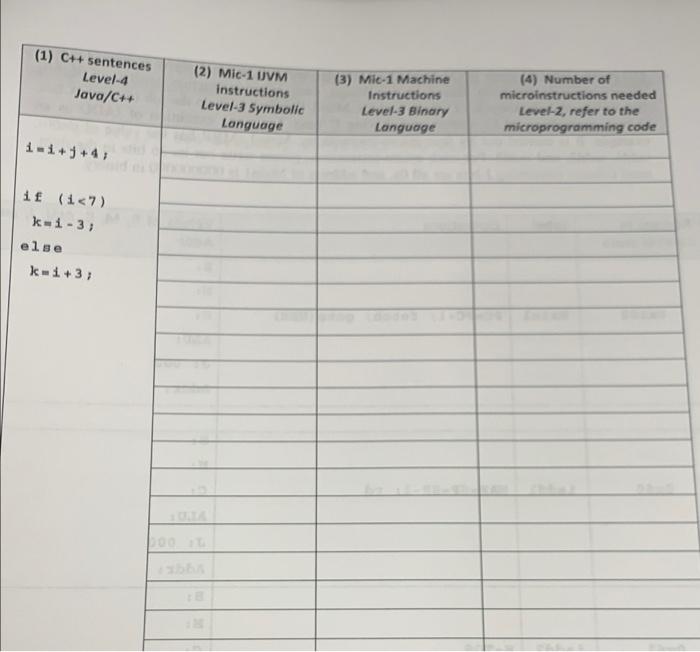
3. [30 points, level-2, -3, and -4] this question involves Level-4 "High language level”, Level-3 "Machine language level (ISA)", and Level-2 "Microprogramming level". Use the table on next page to answer the following four questions. a) [10 points) Translate/Java the C++ code segment (1" column in the table below, Level-4) into Mic- 1 IJVM machine language (2nd column, Level-3), assuming i, j, and k are the 1st, the 2nd and the 3rd local variables, respectively. b) [10 points) Translate the code in Mic-1 UVM instructions you derive from question (a) above (Level-3 symbolic language) into Mic-1 machine instructions (3 column, Level-3 binary language). Please use hexadecimals to represent machine language instructions. c) [10 points) For each Mic-1 machine instruction in Column 3. in Column 4 write the number of Mic- 1 micro-instructions (Level-2) needed to interpret the machine instruction. Don't forget the Mainl micro-instruction If the initial values of the three local variables are i=1, j=1, k=0, respectively, how many nanoseconds does it take for a 1-GHz Mic-1 computer to execute this C++ code segment?
(1) C++ sentences Level 4 Java/C++ (2) Mic-1 UJVM Instructions Level-3 Symbolic Language (3) Mic-1 Machine Instructions Level-3 Binary Language (4) Number of microinstructions needed Level-2, refer to the microprogramming code i=i+1+4) if(i<7) k-i-3; else k-i+3;