Page 1 of 1
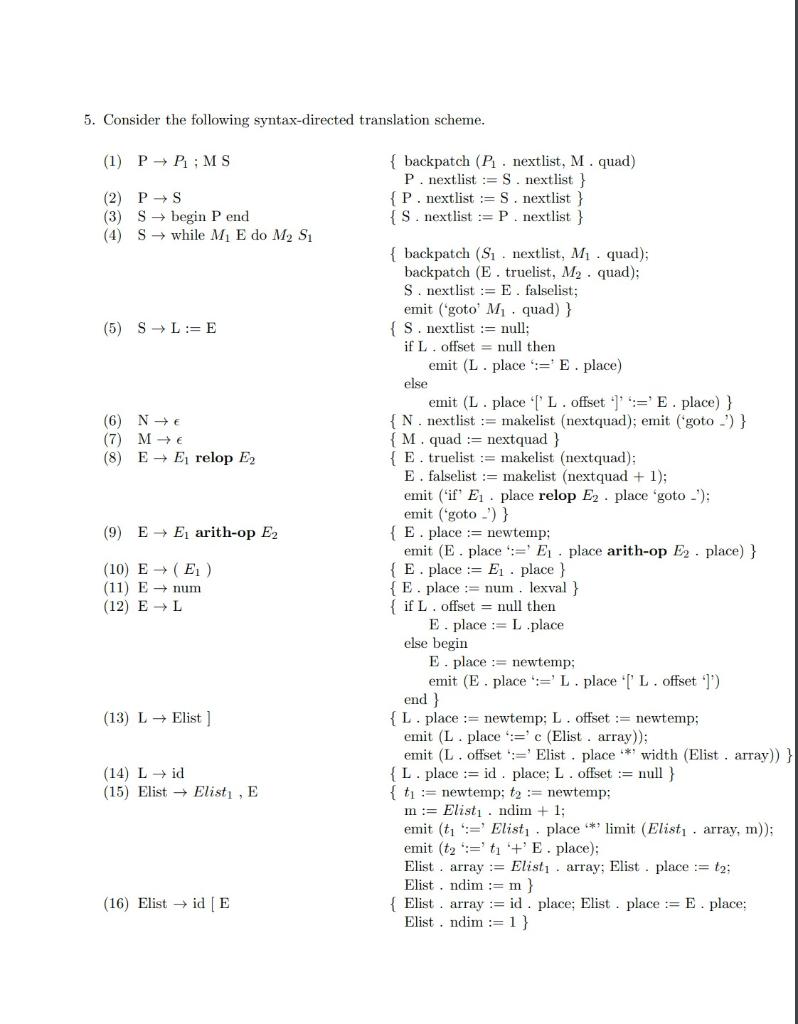
5. Consider the following syntax-directed translation scheme. (1) P→ P:MS (2) PS (3) S begin Pend (4) S→ while M E do M2
Posted: Sat May 14, 2022 4:56 pm
by answerhappygod
- 5 Consider The Following Syntax Directed Translation Scheme 1 P P Ms 2 Ps 3 S Begin Pend 4 S While M E Do M2 1 (82.94 KiB) Viewed 33 times
- 5 Consider The Following Syntax Directed Translation Scheme 1 P P Ms 2 Ps 3 S Begin Pend 4 S While M E Do M2 2 (40.23 KiB) Viewed 33 times
5. Consider the following syntax-directed translation scheme. (1) P→ P:MS (2) PS (3) S begin Pend (4) S→ while M E do M2 Si { backpatch (P1 . nextlist, M. quad) P. nextlist := S. nextlist {P. nextlist := S. nextlist } { S. nextlist :=Pnextlist } (5) SL:=E (6) N → (7) M → (8) E E relop E2 (9) E E, arith-op E2 (10) E (E) (11) Enum (12) EL { backpatch (Si . nextlist, M . quad); backpatch (E. truelist, M. quad); S. nextlist := E. falselist; emit ("goto' M . quad) } { S. nextlist := null; if L . offset = null then emit (L . place := E. place) else emit (L . place '' L . offset '=' E. place) } {N. nextlist := makelist (nextquad); emit ('goto-') } {M. quad := nextquad } { E. truelist := makelist (nextquad); E. falselist := makelist (nextquad + 1); emit (if Ei place relop E2 · place 'goto -); emit ("goto -') } { E. place := newtemp; emit (E. place := Ei place arith-op E, . place) } { E. place := Ej . place } {E. place := num. lexval } { if L . offset = null then E.place := L .place else begin E place := newtemp: emit (E. place :=' L . place [' L . offset 1) end {L. place := newtemp; L. offset := newtemp; emit (L. place='c (Elist . array)); emit (L. offset :=' Elist. place *** width (Elist. array)) } {L. place := id. place; L. offset := null } { t = newtemp; t2 := newtemp: m:= Elisti . ndim + 1; emit (t1 :=' Elist, place "*" limit (Elist, array, m)); emit (t2 ":='t'+'E. place); Elist array := Elist1 . array; Elist place := t2: Elist . ndim :=m} { Elist array := id. place; Elist. place := E. place: Elist . ndim := 1) (13) L → Elist] (14) Lid (15) Elist → Elisti , E (16) Elist →id [E
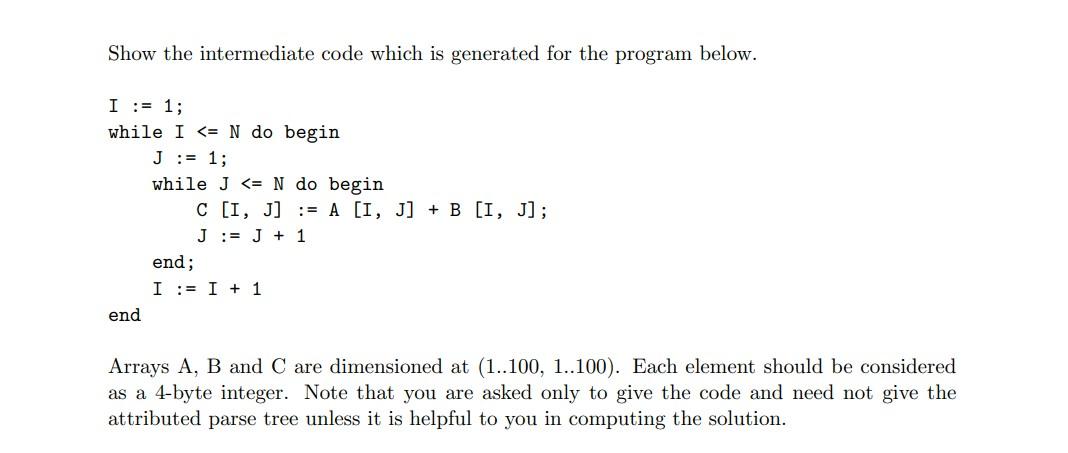
Show the intermediate code which is generated for the program below. I := 1; while I <= N do begin J: = 1; while J <= N do begin C[I, J] := A (I, J] + B [I, J]; J := J + 1 end; I := I + 1 end Arrays A, B and C are dimensioned at (1..100, 1..100). Each element should be considered as a 4-byte integer. Note that you are asked only to give the code and need not give the attributed parse tree unless it is helpful to you in computing the solution.