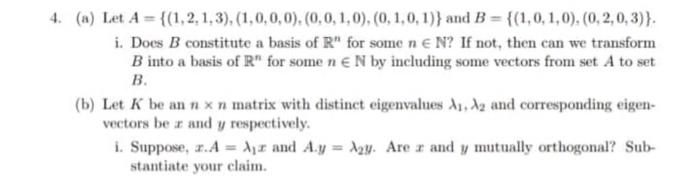
- 4 A Let A 1 2 1 3 1 0 0 0 0 0 1 0 0 1 0 1 And B 1 0 1 0 0 2 0 3 I Does B Constitute A Basis 1 (16.34 KiB) Viewed 48 times
4. (a) Let A = {(1,2,1,3), (1,0,0,0), (0,0,1,0), (0,1,0,1)} and B = {(1,0,1,0), (0,2,0,3)}. i. Does B constitute a basis of R" for some ne N? If not, then can we transform B into a basis of " for some n E N by including some vectors from set A to set B. (b) Let K be an n x n matrix with distinct eigenvalues , Ay and corresponding eigen- vectors be x and y respectively. i. Suppose, a.A = 1r and A.y = 12y. Are r and y mutually orthogonal? Sub- stantiate your claim.