Page 1 of 1
1.26. Assume that the first beam splitter at A in the Mach-Zehnder interferometer (Fig. 1.23) is a "third-silvered mirro
Posted: Thu May 12, 2022 2:07 pm
by answerhappygod
- 1 26 Assume That The First Beam Splitter At A In The Mach Zehnder Interferometer Fig 1 23 Is A Third Silvered Mirro 1 (345.35 KiB) Viewed 30 times
- 1 26 Assume That The First Beam Splitter At A In The Mach Zehnder Interferometer Fig 1 23 Is A Third Silvered Mirro 2 (145.22 KiB) Viewed 30 times
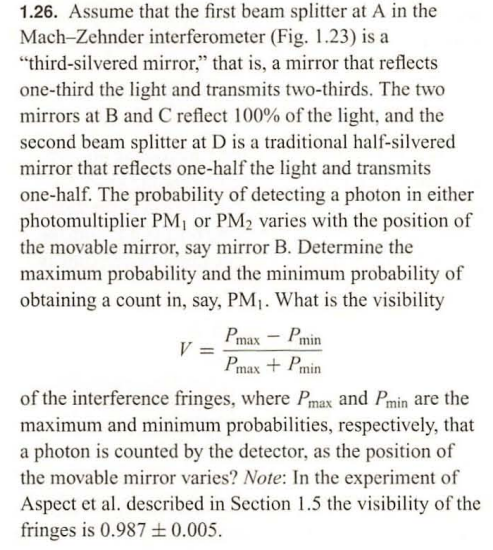
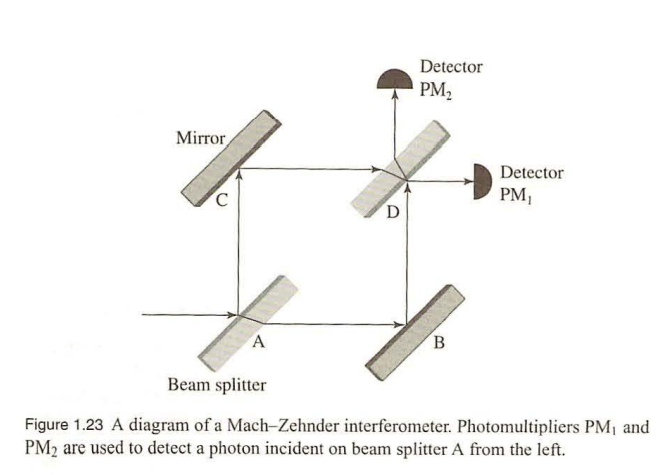
1.26. Assume that the first beam splitter at A in the Mach-Zehnder interferometer (Fig. 1.23) is a "third-silvered mirror," that is, a mirror that reflects one-third the light and transmits two-thirds. The two mirrors at B and C reflect 100% of the light, and the second beam splitter at D is a traditional half-silvered mirror that reflects one-half the light and transmits one-half. The probability of detecting a photon in either photomultiplier PM, or PM2 varies with the position of the movable mirror, say mirror B. Determine the maximum probability and the minimum probability of obtaining a count in, say, PM. What is the visibility Pmax – Pmin V Pmax + Pmin of the interference fringes, where Pmax and Pmin are the maximum and minimum probabilities, respectively, that a photon is counted by the detector, as the position of the movable mirror varies? Note: In the experiment of Aspect et al. described in Section 1.5 the visibility of the fringes is 0.987 +0.005.
Detector PM, Mirror Detector PM с A B Beam splitter Figure 1.23 A diagram of a Mach-Zehnder interferometer. Photomultipliers PM, and PM2 are used to detect a photon incident on beam splitter A from the left.