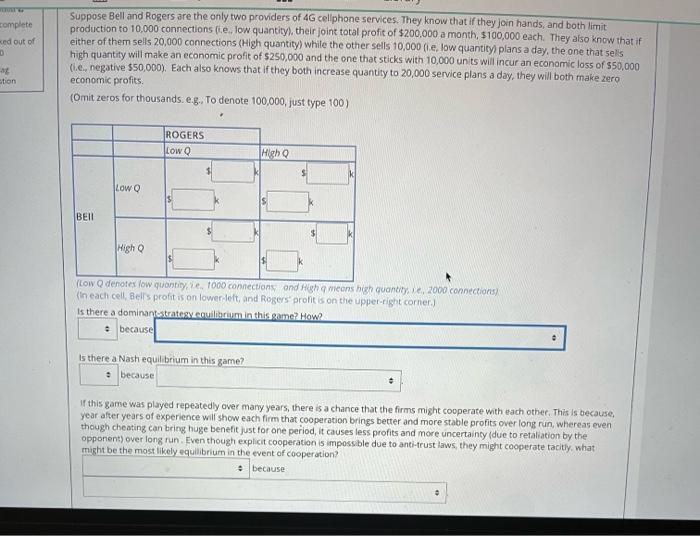
- Complete Ced Out Of 0 Suppose Bell And Rogers Are The Only Two Providers Of 4g Cellphone Services They Know That If The 1 (56.75 KiB) Viewed 22 times
complete ced out of 0 Suppose Bell and Rogers are the only two providers of 4G cellphone services. They know that if they join hands and both limit production to 10,000 connections (.e. low quantity), their joint total profit of $200,000 a month, $100,000 each. They also know that if either of them sells 20,000 connections (High quantity) while the other sells 10,000 (e, low quantity plans a day, the one that sells high quantity will make an economic profit of $250,000 and the one that sticks with 10,000 units will incur an economic loss of $50,000 (lie, negative $50,000). Each also knows that if they both increase quantity to 20,000 service plans a day, they will both make zero economic profits (Omit zeros for thousands. e.g., To denote 100,000, just type 100) stion ROGERS Low High Q Lowo BENI High flow denotes low quantity te 1000 connections and High a means high quantity, 2000 connections (in each cell Bells profit is on lower left, and Rogers profit is on the upper right corner) Is there a dominant strategy couilibrium in this game? How? • because Is there a Nash equilibrium in this game? • because of this game was played repeatedly over many years, there is a chance that the firms might cooperate with each other. This is because year after years of experience will show each firm that cooperation brings better and more stable profits over long run, whereas even though cheating can bring huge benefit just for one period, it causes less profits and more uncertainty due to retaliation by the opponent) over long run. Even though explicit cooperation is impossible due to anti-trust laws they might cooperate tactly what might be the most likely equilibrium in the event of cooperation? • because