Page 1 of 1
10. [2/15 Points] DETAILS PREVIOUS ANSWERS ZILLDIFFEQMODAP11 2.5.011.MI.SA. MY NOTES ASK This question has several parts
Posted: Wed May 11, 2022 11:03 pm
by answerhappygod
- 10 2 15 Points Details Previous Answers Zilldiffeqmodap11 2 5 011 Mi Sa My Notes Ask This Question Has Several Parts 1 (42.88 KiB) Viewed 15 times
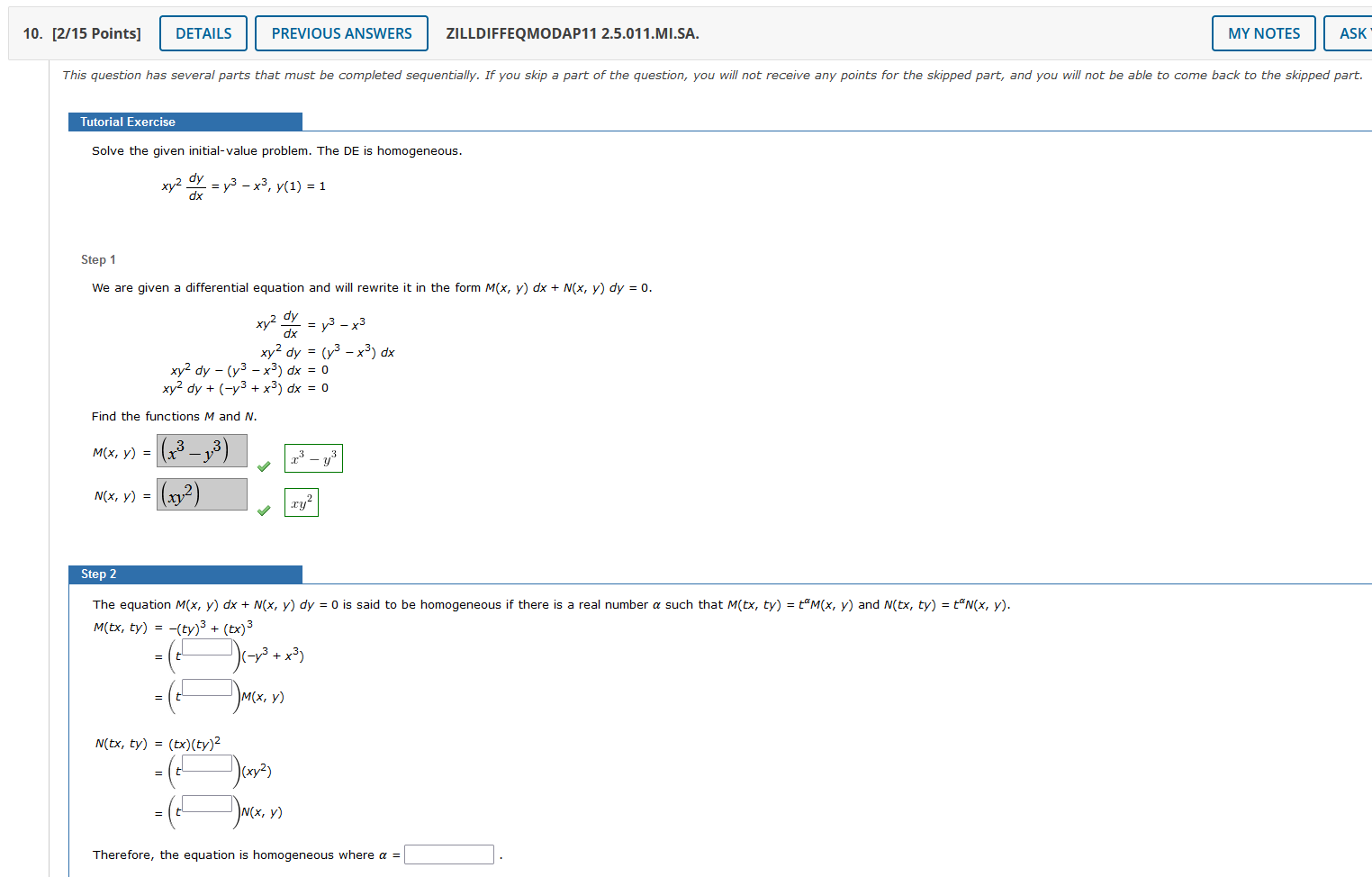
10. [2/15 Points] DETAILS PREVIOUS ANSWERS ZILLDIFFEQMODAP11 2.5.011.MI.SA. MY NOTES ASK This question has several parts that must be completed sequentially. If you skip a part of the question, you will not receive any points for the skipped part, and you will not be able to come back to the skipped part. Tutorial Exercise Solve the given initial-value problem. The DE is homogeneous. dy xy2 = y3 – x3, y(1) = 1 Step 1 We are given a differential equation and will rewrite it in the form M(x, y) dx + N(x, y) dy = 0. xy2 dy = y3 – x3 dx xy2 dy = (V3 – x3) dx xy2 dy -(y3 – x3) dx = 0 xy2 dy + (-y3 + x3) dx = 0 functions M and N. 3 M(x, y) = (x3 –,3) (xy2) N(x, y) = cy Step 2 The equation M(x,y) dx + N(x,y) dy = 0 is said to be homogeneous if there is a real number a such that M(tx, ty) = +"M(x, y) and N(tx, ty) = +"N(x, y). M(tx, ty) = -(ty)3 + (tx) 3 ( - = Dr-x+x2 ) -) M(x, y) N(tx, ty) = (tx)(ty) = Jxy? Nx, y) ) Therefore, the equation is homogeneous where a =