Page 1 of 1
(b)i. The grammar allows 'is a N' where N is a noun to be treated as vp, and there is a semantic case for this equating
Posted: Wed May 11, 2022 10:53 pm
by answerhappygod
- B I The Grammar Allows Is A N Where N Is A Noun To Be Treated As Vp And There Is A Semantic Case For This Equating 1 (132.23 KiB) Viewed 16 times
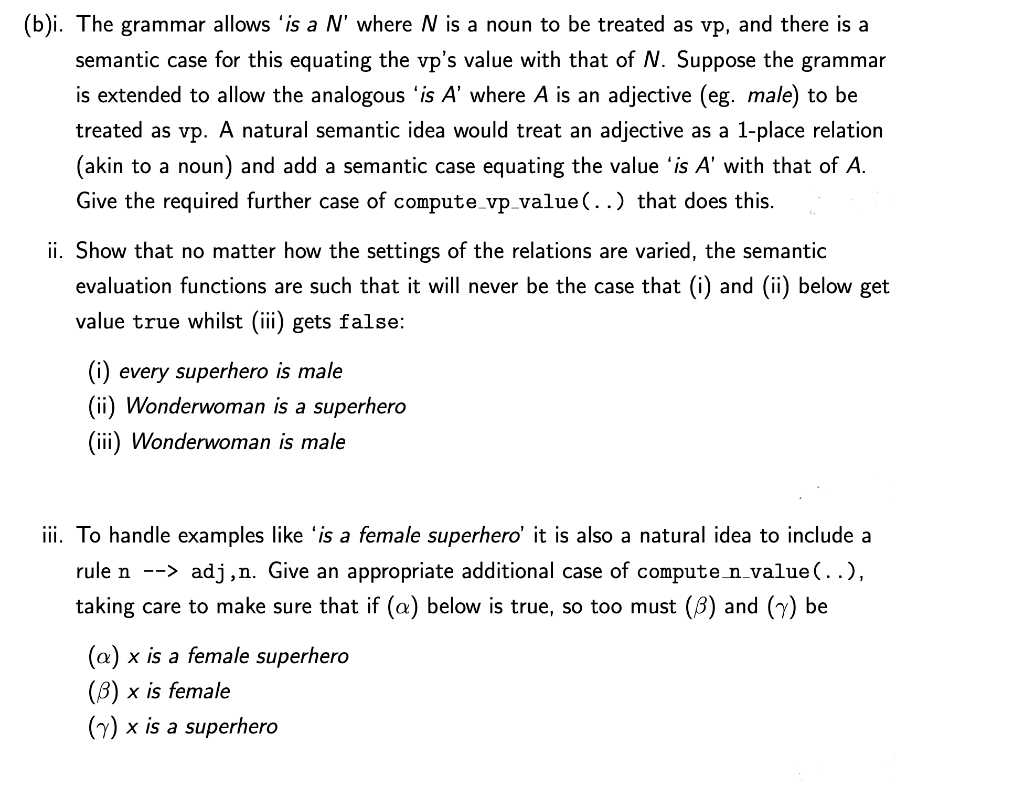
(b)i. The grammar allows 'is a N' where N is a noun to be treated as vp, and there is a semantic case for this equating the vp's value with that of N. Suppose the grammar is extended to allow the analogous 'is A' where A is an adjective (eg. male) to be treated as vp. A natural semantic idea would treat an adjective as a 1-place relation (akin to a noun) and add a semantic case equating the value 'is A' with that of A. Give the required further case of compute_vp_value(..) that does this. ii. Show that no matter how the settings of the relations are varied, the semantic evaluation functions are such that it will never be the case that (i) and (ii) below get value true whilst (iii) gets false: (i) every superhero is male (ii) Wonderwoman is a superhero (ii) Wonderwoman is male iii. To handle examples like 'is a female superhero' it is also a natural idea to include a rule n --> adj,n. Give an appropriate additional case of compute n_value(..), taking care to make sure that if (a) below is true, so too must (8) and (7) be (a) x is a female superhero (B) x is female () x is a superhero