- X Question 2 13 Marks A How Many Different Elements Does P B X A Have If A Has 5 Elements And B Has M Elements 1 (31.61 KiB) Viewed 26 times
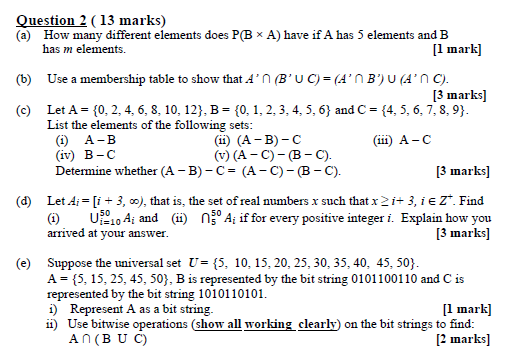
X = Question 2 ( 13 marks) (a) How many different elements does P(B x A) have if A has 5 elements and B has m elements. [1 mark] (b) Use a membership table to show that A' n(B’U C)= (A’n B') U (A'nC). [3 marks] () Let A = {0,2, 4, 6, 8, 10, 12}, B = {0, 1, 2, 3, 4, 5, 6} and C = {4,5,6,7,8,9}. List the elements of the following sets: (1) A-B (11) (A-B-C (iii) A-C (iv) B-C (v) (A-C)-(B-C). Determine whether (A-B) - C = (A-C)-(B-C). [3 marks) (d) Let A;= [i + 3,co), that is, the set of real numbers x such that x2i+3, i E Z. Find (1) V 10A; and (1) n50 A; if for every positive integer i. Explain how you arrived at your answer. [3 marks] (e) Suppose the universal set U= {5, 10, 15, 20, 25, 30, 35, 40, 45, 50). A = {5, 15, 25, 45, 50), B is represented by the bit string 0101100110 and C is represented by the bit string 1010110101. 1) Represent A as a bit string. [1 mark] 11) Use bitwise operations (show all working clearly) on the bit strings to find: AN(BUC) [2 marks] i=