- 1 Mark 2 Marks 2 Answer Either This Question Or Question 3 Tenenbaum S Concept Model Was Used To Predict Behavior 1 (215.7 KiB) Viewed 39 times
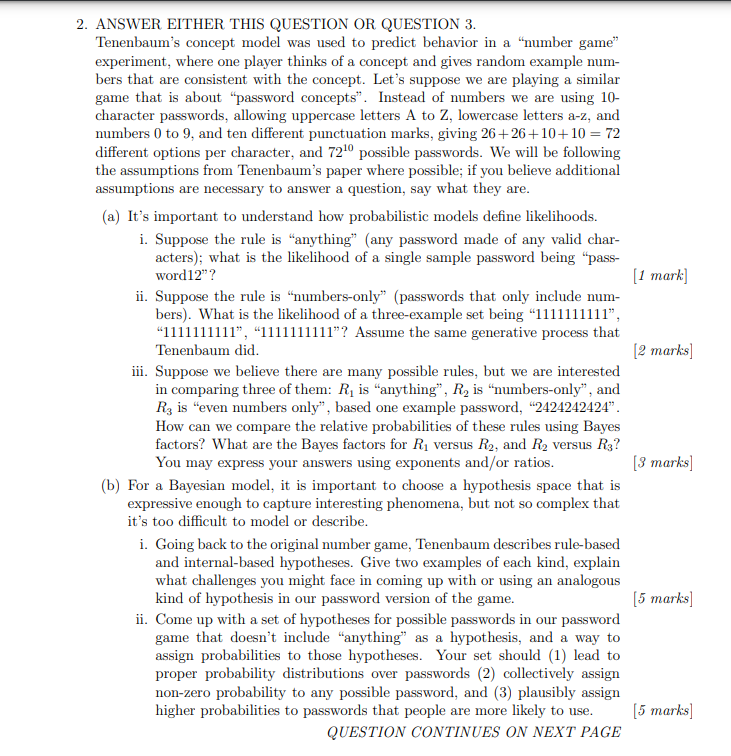
[1 mark] [2 marks] 2. ANSWER EITHER THIS QUESTION OR QUESTION 3. Tenenbaum's concept model was used to predict behavior in a "number game” experiment, where one player thinks of a concept and gives random example num- bers that are consistent with the concept. Let's suppose we are playing a similar game that is about "password concepts”. Instead of numbers we are using 10- character passwords, allowing uppercase letters A to Z, lowercase letters a-z, and numbers 0 to 9, and ten different punctuation marks, giving 26 +26+10+10 = 72 different options per character, and 7210 possible passwords. We will be following the assumptions from Tenenbaum's paper where possible; if you believe additional assumptions are necessary to answer a question, say what they are. (a) It's important to understand how probabilistic models define likelihoods. i. Suppose the rule is "anything" (any password made of any valid char- acters); what is the likelihood of a single sample password being "pass- word 12"? ii. Suppose the rule is "numbers-only" (passwords that only include num- bers). What is the likelihood of a three-example set being "1111111111", "1111111111", "1111111111"? Assume the same generative process that Tenenbaum did. iii. Suppose we believe there are many possible rules, but we are interested in comparing three of them: R is anything", R, is "numbers-only", and Rz is "even numbers only", based one example password, "2424242424". How can we compare the relative probabilities of these rules using Bayes factors? What are the Bayes factors for Ry versus R2, and Rversus R3? You may express your answers using exponents and/or ratios. (b) For a Bayesian model, it is important to choose a hypothesis space that is expressive enough to capture interesting phenomena, but not so complex that it's too difficult to model or describe. i. Going back to the original number game, Tenenbaum describes rule-based and internal-based hypotheses. Give two examples of each kind, explain what challenges you might face in coming up with or using an analogous kind of hypothesis in our password version of the game. ii. Come up with a set of hypotheses for possible passwords in our password game that doesn't include "anything” as a hypothesis, and a way to assign probabilities to those hypotheses. Your set should (1) lead to proper probability distributions over passwords (2) collectively assign non-zero probability to any possible password, and (3) plausibly assign higher probabilities to passwords that people are more likely to use. QUESTION CONTINUES ON NEXT PAGE [3 marks) [5 marks] [5 marks)
QUESTION CONTINUED FROM PREVIOUS PAGE (c) Tenenbaum's paper mentions two free parameters. One is , which governs the bias toward rule-based verus interval-based concepts. The second is o, which assigns probabilities to different interval lengths. The original value of o was chosen to favor small intervals, with intervals longer than 10 being unlikely. i. Suppose the example numbers (X) are 2 and 8. If o is changed to assign high probability to larger intervals (e.g., longer than 30), what happens to the model's predictions about the relative probabilities of numbers 4 and 7 being in the concept? That is, how does the ratio P(4EC X=(2,8}) P(TEC|X={2.8}) change? Briefly explain why. Mention the prior and/or likelihood as appropriate. ii. Suppose we believe there are two kinds of participants in the game: those who favour concepts based on mathematical rules and those who favour interval-based concepts. How can we build on Tenenbaum's model to test this idea, supposing that each participant plays 20 different variations on the number game? Assume that o is fixed, and you have a function that gives you the probability of a particular judgment given the examples in the game as well as I, expressed as Pjudgment(y e C|X, X). (4 marks) [5 marks)