Page 1 of 1
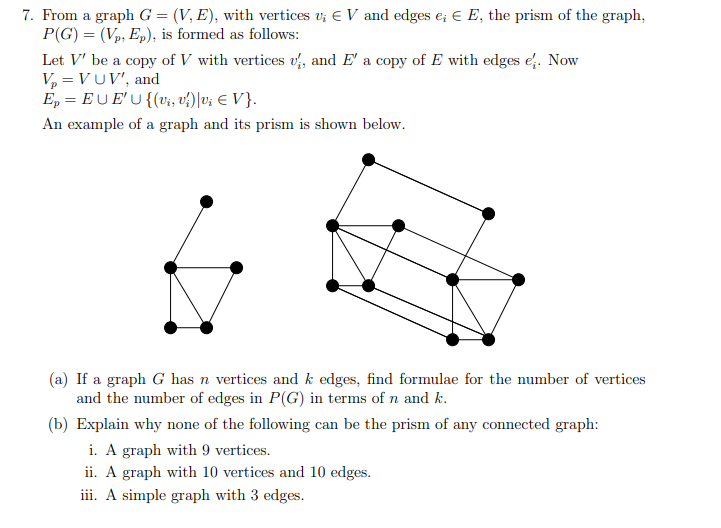
7. From a graph G = (V, E), with vertices v; EV and edges ei € E, the prism of the graph, P(G) = (Vp, Ep), is formed as
Posted: Wed May 11, 2022 9:28 pm
by answerhappygod
- 7 From A Graph G V E With Vertices V Ev And Edges Ei E The Prism Of The Graph P G Vp Ep Is Formed As 1 (72.24 KiB) Viewed 31 times
7. From a graph G = (V, E), with vertices v; EV and edges ei € E, the prism of the graph, P(G) = (Vp, Ep), is formed as follows: Let V' be a copy of V with vertices ví, and E' a copy of E with edges e. Now V = VUV', and En = EU E' U{(vi, v£)|v; € V}. An example of a graph and its prism is shown below. (a) If a graph G has n vertices and k edges, find formulae for the number of vertices and the number of edges in P(G) in terms of n and k. (b) Explain why none of the following can be the prism of any connected graph: i. A graph with 9 vertices. ii. A graph with 10 vertices and 10 edges. iii. A simple graph with 3 edges.