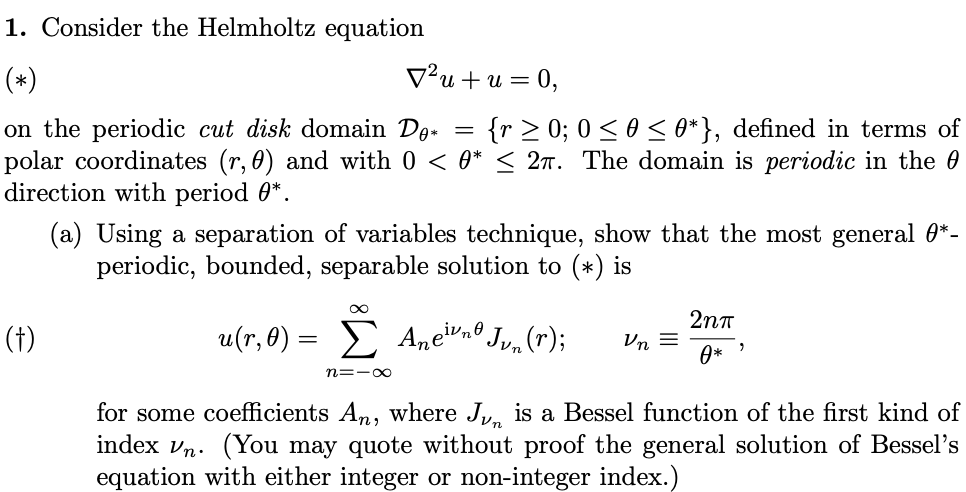
1. Consider the Helmholtz equation (*) v?u + 1 = 0, on the periodic cut disk domain De* = {r > 0; 0
Posted: Wed May 11, 2022 9:13 pm
- 1 Consider The Helmholtz Equation V U 1 0 On The Periodic Cut Disk Domain De R 0 0 O 0 Defined In T 1 (79.46 KiB) Viewed 21 times
1. Consider the Helmholtz equation (*) v?u + 1 = 0, on the periodic cut disk domain De* = {r > 0; 0 <O<0*}, defined in terms of polar coordinates (r, 0) and with 0 < 0* < 27. The domain is periodic in the 0 direction with period 0*. (a) Using a separation of variables technique, show that the most general 6*- periodic, bounded, separable solution to (*) is 2nn (+) u(r, 0) = Ë Aneivono. no Jun (r); Vn = O* = n=- for some coefficients An, where Jun is a Bessel function of the first kind of index Vn. (You may quote without proof the general solution of Bessel's equation with either integer or non-integer index.)
Posted: Wed May 11, 2022 9:13 pm
- 1 Consider The Helmholtz Equation V U 1 0 On The Periodic Cut Disk Domain De R 0 0 O 0 Defined In T 1 (79.46 KiB) Viewed 21 times