Page 1 of 1
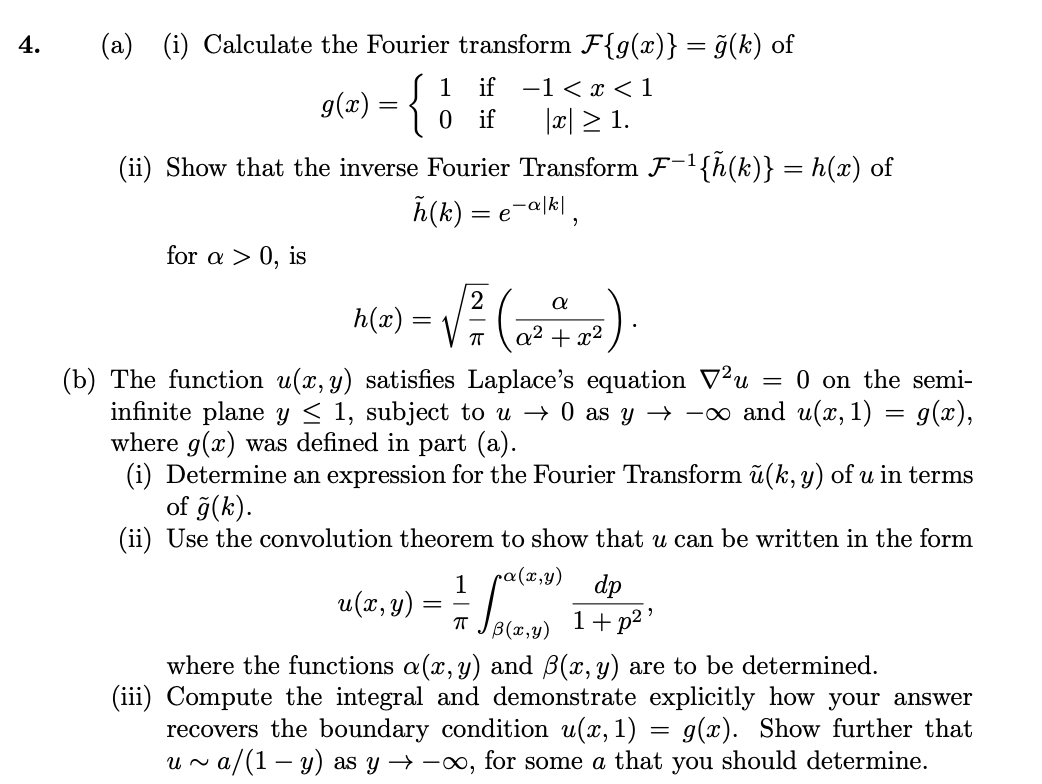
4. 1 g(x) = { { (a) (i) Calculate the Fourier transform F{g(x)} = õ(k) of if -1 < x < 1 0 if | 20 > 1. (ii) Show that th
Posted: Wed May 11, 2022 9:11 pm
by answerhappygod
- 4 1 G X A I Calculate The Fourier Transform F G X O K Of If 1 X 1 0 If 20 1 Ii Show That Th 1 (119.4 KiB) Viewed 27 times
4. 1 g(x) = { { (a) (i) Calculate the Fourier transform F{g(x)} = õ(k) of if -1 < x < 1 0 if | 20 > 1. (ii) Show that the inverse Fourier Transform F-1{ñ(k)} = h(x) of Ñ(k) = e-alkl, for a > 0, is =e 2 a h(a) = V1 (242) = T ( a2 + x2 (b) The function u(x, y) satisfies Laplace's equation Vều = 0 on the semi- infinite plane y < 1, subject to u → 0 as y + - and u(x, 1) = g(x), where g(x) was defined in part (a). (i) Determine an expression for the Fourier Transform ū(k, y) of u in terms of ğ(k). (ii) Use the convolution theorem to show that u can be written in the form pa(x,y) dp , B(x,y) 1+p2' where the functions a(x,y) and B(x, y) are to be determined. (iii) Compute the integral and demonstrate explicitly how your answer recovers the boundary condition u(x, 1) = g(x). Show further that u~ a/(1 – y) as y +-0, for some a that you should determine. 1 = u(x, y) = = Scolios TT