Page 1 of 1
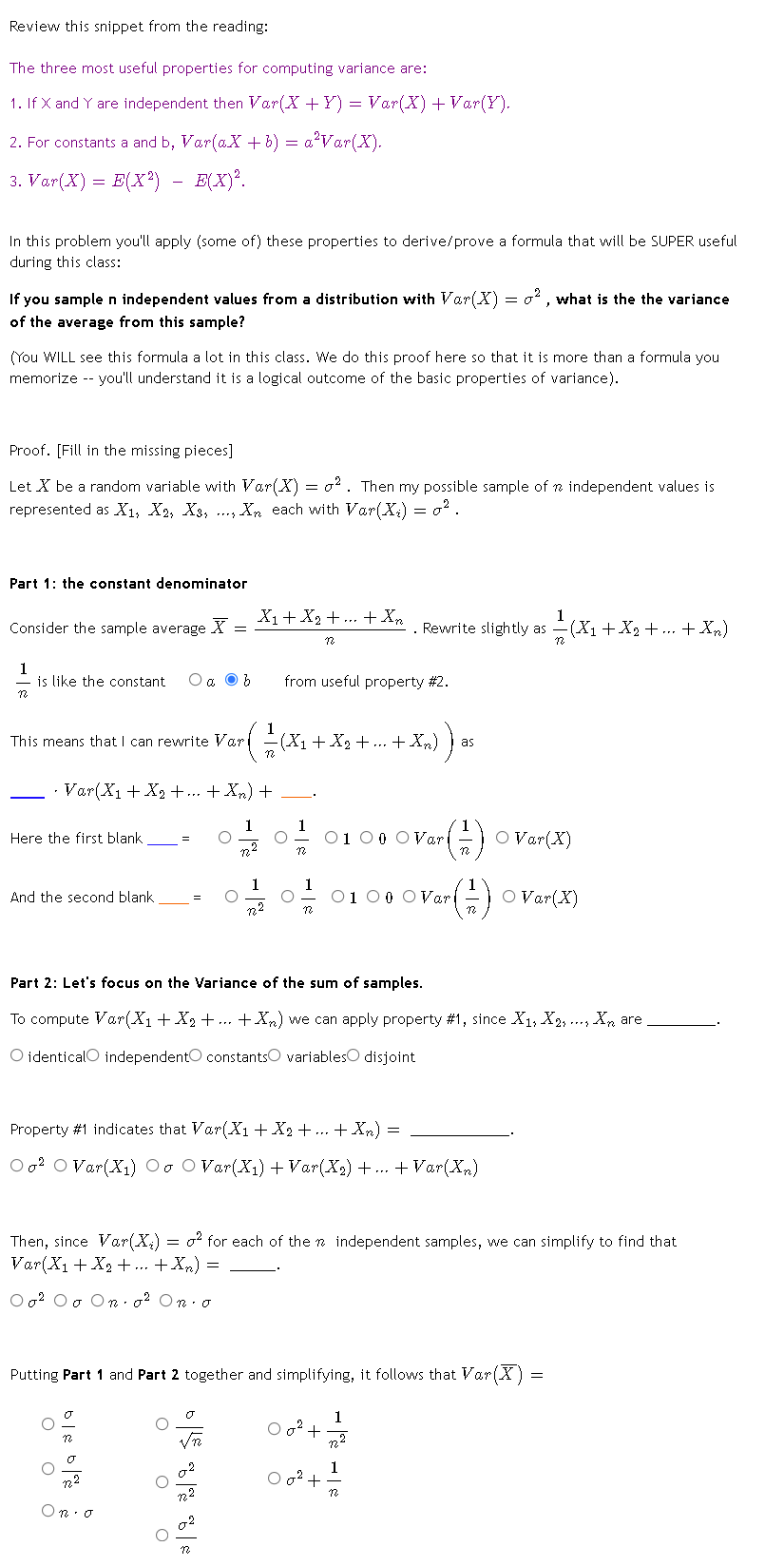
Review this snippet from the reading: The three most useful properties for computing variance are: 1. If X and Y are ind
Posted: Wed May 11, 2022 7:42 pm
by answerhappygod
- Review This Snippet From The Reading The Three Most Useful Properties For Computing Variance Are 1 If X And Y Are Ind 1 (53.25 KiB) Viewed 21 times
Review this snippet from the reading: The three most useful properties for computing variance are: 1. If X and Y are independent then Var(X+Y) = Var(X) + Var(Y). = = 2. For constants a and b, Var(aX+b) = a?Var(X). 3. Var(X) = E(X2) - E(X2) - E(X)? ( = In this problem you'll apply (some of) these properties to derive/prove a formula that will be SUPER useful during this class: = If you sample n independent values from a distribution with Var(X) = , what is the the variance of the average from this sample? (You WILL see this formula a lot in this class. We do this proof here so that it is more than a formula you memorize -- you'll understand it is a logical outcome of the basic properties of variance). Proof. (Fill in the missing pieces] = Let X be a random variable with Var(X) = 0%. Then my possible sample of n independent values is represented as X1, X2, X3, ..., Xn each with Var(X) = 02. , = " Part 1: the constant denominator X1 + X2 + ... + Xn Consider the sample average X = 1 ( = - Rewrite slightly as (X1 + Xx +...+Xn) 12 1 is like the constant O a ob b from useful property #2. 12 This means that I can rewrite Var(*(*1 +Xz++X») ) as .... X 12 · Var(X1 + X2 + ... + Xn) + 1 1 Here the first blank 01 OO O Var ar() O Var(X) 124 12 12 o x] Var (5) 1 1 And the second blank OOO 0 01 OO O Var O Var(X) n2 12 12 Part 2: Let's focus on the Variance of the sum of samples. To compute Var(X1 + Xg+ ... + Xn) we can apply property #1, since X1, X2, ..., Xn are ? O identical independent constants variables disjoint Property #1 indicates that Var( X1 + X2 + ... + Xn) = = 002 O Var(X1) Oo O Var(X1) + Var(X2) + ... + Var(Xn) = Then, since Var(X) = o2 for each of the n independent samples, we can simplify to find that Var(X1 + X2 + ... +Xn) = = Οσ2 Οσ Οη, σ2 Οησ Putting Part 1 and Part 2 together and simplifying, it follows that Var(X) = = 1 O 02 + 12 9319 оо n2 2 3. 4. 59 1 O 02 + + 12 12:0 O