- An Economic Organization Tracks Summary Statistics Of Various Countries These Include Gdp Gross Domestic Product Per C 1 (83.85 KiB) Viewed 22 times
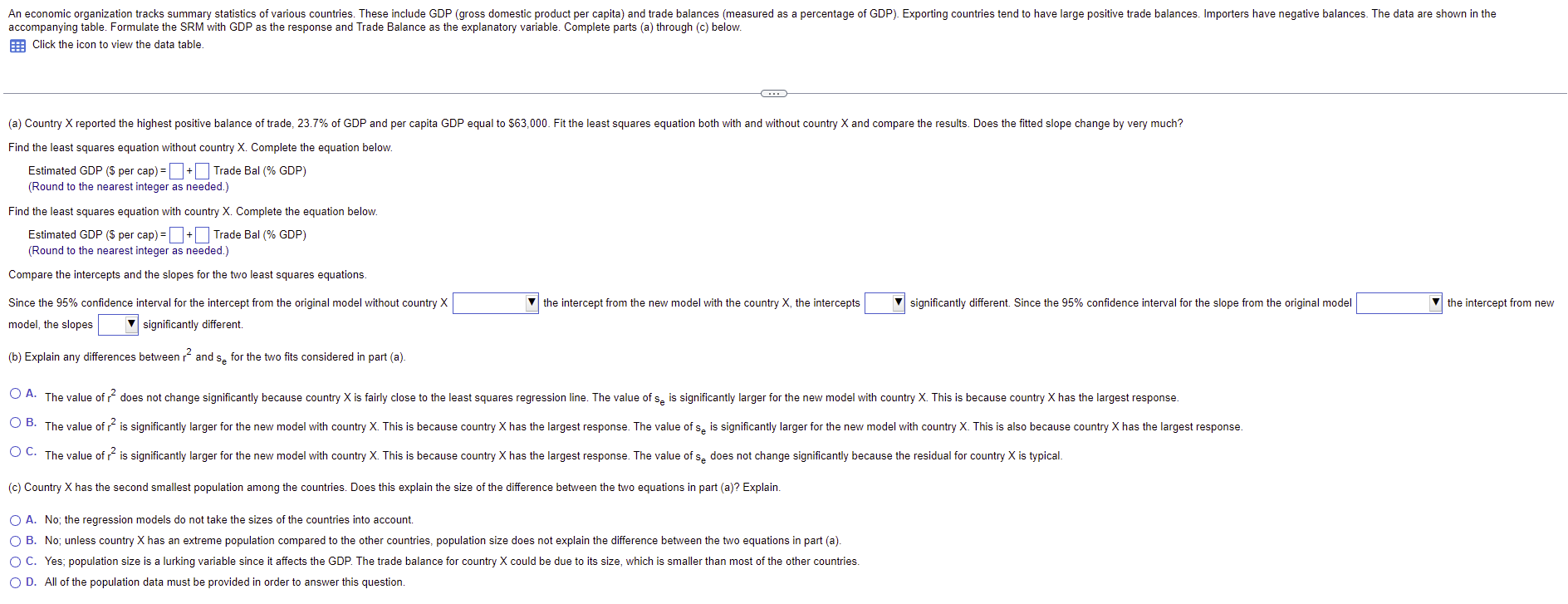
An economic organization tracks summary statistics of various countries. These include GDP (gross domestic product per capita) and trade balances (measured as a percentage of GDP). Exporting countries tend to have large positive trade balances. Importers have negative balances. The data are shown in the accompanying table. Formulate the SRM with GDP as the response and Trade Balance as the explanatory variable. Complete parts (a) through (c) below. Click the icon to view the data table. (a) Country X reported the highest positive balance of trade, 23.7% of GDP and per capita GDP equal to $63,000. Fit the least squares equation both with and without country X and compare the results. Does the fitted slope change by very much? Find the least squares equation without country X. Complete the equation below. Estimated GDP (5 per cap)= + Trade Bal (% GDP) (Round to the nearest integer as needed.) Find the least squares equation with country X. Complete the equation below. Estimated GDP (5 per cap) =+ Trade Bal (% GDP) (Round to the nearest integer as needed.) Compare the intercepts and the slopes for the two least squares equations. the intercept from the new model with the country X, the intercepts significantly different. Since the 95% confidence interval for the slope from the original model the intercept from new Since the 95% confidence interval for the intercept from the original model without country X model, the slopes V significantly different. (b) Explain any differences between and se for the two fits considered in part (a). O A. The value of ? does not change significantly because country X is fairly close to the least squares regression line. The value of se is significantly larger for the new model with country X. This is because country X has the largest response. 12 OB. The value ofr? is significantly larger for the new model with country X. This is because country X has the largest response. The value of se is significantly larger for the new model with country X. This is also because country X has the largest response. OC. The value ofr? is significantly larger for the new model with country X. This is because country X has the largest response. The value of se does not change significantly because the residual for country X is typical. (c) Country X has the second smallest population among the countries. Does this explain the size of the difference between the two equations in part (a)? Explain. O A. No, the regression models do not take the sizes of the countries into account. OB. No, unless country X has an extreme population compared to the other countries, population size does not explain the difference between the two equations in part (a). OC. Yes, population size is a lurking variable since it affects the GDP. The trade balance for country X could be due to its size, which is smaller than most of the other countries. OD. All of the population data must be provided in order to answer this question.
Trade Balance (% GDP) 3.6 15.1 0.2 -8.6 -7.2 8.7 10.1 -0.6 -2.8 -6.9 13.2 15.1 5.6 10.2 3.4 5.5 -5.9 8.4 0.1 10.8 GDP ($ per capita) 31,108 43,524 40,859 25,797 1,729 37,881 44,456 28,574 36,318 31,587 49,056 59,438 14,325 33,586 45,208 21,874 26,799 58,878 16,951 31,052