Page 1 of 1
z = Notes and examples: In class, we looked at the difference between the probability of a single data point occurring v
Posted: Wed May 11, 2022 3:21 pm
by answerhappygod
- Z Notes And Examples In Class We Looked At The Difference Between The Probability Of A Single Data Point Occurring V 1 (75.71 KiB) Viewed 22 times

- Z Notes And Examples In Class We Looked At The Difference Between The Probability Of A Single Data Point Occurring V 2 (13.54 KiB) Viewed 22 times
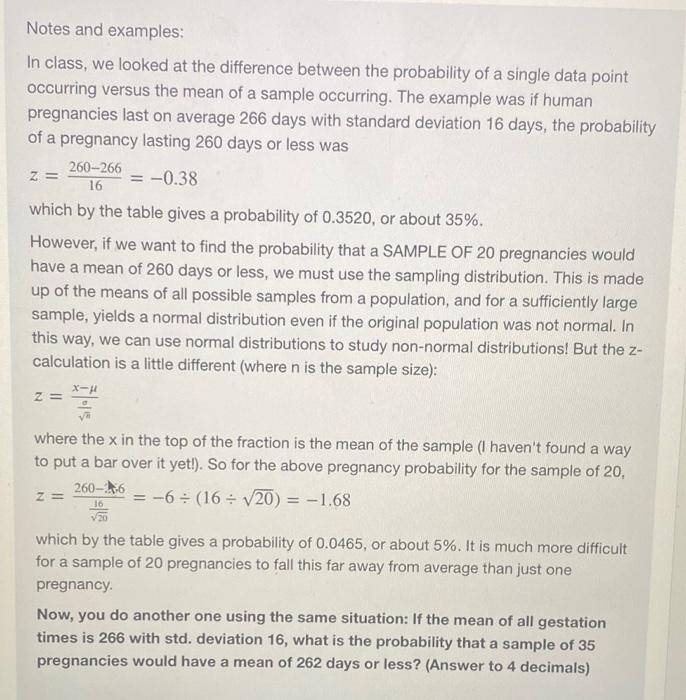
z = Notes and examples: In class, we looked at the difference between the probability of a single data point occurring versus the mean of a sample occurring. The example was if human pregnancies last on average 266 days with standard deviation 16 days, the probability of a pregnancy lasting 260 days or less was 260-266 = -0.38 16 which by the table gives a probability of 0.3520, or about 35%. However, if we want to find the probability that a SAMPLE OF 20 pregnancies would have a mean of 260 days or less, we must use the sampling distribution. This is made up of the means of all possible samples from a population, and for a sufficiently large sample, yields a normal distribution even if the original population was not normal. In this way, we can use normal distributions to study non-normal distributions! But the z- calculation is a little different (where n is the sample size): X- Z= where the x in the top of the fraction is the mean of the sample (I haven't found a way to put a bar over it yet!). So for the above pregnancy probability for the sample of 20, 260-66 -6 = (16 = 20) = -1.68 - which by the table gives a probability of 0.0465, or about 5%. It is much more difficult for a sample of 20 pregnancies to fall this far away from average than just one pregnancy Now, you do another one using the same situation: If the mean of all gestation times is 266 with std. deviation 16, what is the probability that a sample of 35 pregnancies would have a mean of 262 days or less? (Answer to 4 decimals)
Expenses for personal calls at a company are normally distributed and cost on average $399.50 per month with standard deviation $49.75. Find the amount below which 33% of the expenses fall. (round answer to 2 decimals)