Page 1 of 1
The correction (in Excel) in the statistic for unequal variance reduces the df so as to raise the bar for significance.
Posted: Wed May 11, 2022 2:23 pm
by answerhappygod
- The Correction In Excel In The Statistic For Unequal Variance Reduces The Df So As To Raise The Bar For Significance 1 (66.04 KiB) Viewed 25 times
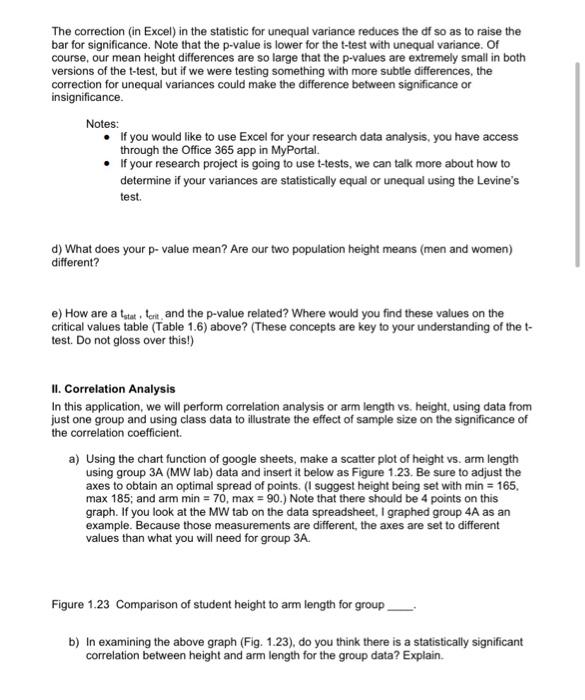
The correction (in Excel) in the statistic for unequal variance reduces the df so as to raise the bar for significance. Note that the p-value is lower for the t-test with unequal variance. Of course, our mean height differences are so large that the p-values are extremely small in both versions of the t-test, but if we were testing something with more subtle differences, the correction for unequal variances could make the difference between significance or insignificance. Notes: If you would like to use Excel for your research data analysis, you have access through the Office 365 app in MyPortal. • If your research project is going to use t-tests, we can talk more about how to determine if your variances are statistically equal or unequal using the Levine's test. d) What does your p-value mean? Are our two population height means (men and women) different? e) How are a tuttore, and the p-value related? Where would you find these values on the critical values table (Table 1.6) above? (These concepts are key to your understanding of the t- test. Do not gloss over this!) II. Correlation Analysis In this application, we will perform correlation analysis or arm length vs. height, using data from just one group and using class data to illustrate the effect of sample size on the significance of the correlation coefficient. a) Using the chart function of google sheets, make a scatter plot of height vs. arm length using group 3A (MW lab) data and insert it below as Figure 1.23. Be sure to adjust the axes to obtain an optimal spread of points. (I suggest height being set with min = 165. max 185; and arm min = 70, max = 90.) Note that there should be 4 points on this graph. If you look at the MW tab on the data spreadsheet. I graphed group 4A as an example. Because those measurements are different, the axes are set to different values than what you will need for group 3A. Figure 1.23 Comparison of student height to arm length for group b) In examining the above graph (Fig. 1.23), do you think there is a statistically significant correlation between height and arm length for the group data? Explain.