Page 1 of 1
It is known that for right-handed people, the dominant (right) hand tends to be stronger. For left- handed people who li
Posted: Wed May 11, 2022 10:43 am
by answerhappygod
- It Is Known That For Right Handed People The Dominant Right Hand Tends To Be Stronger For Left Handed People Who Li 1 (43.85 KiB) Viewed 40 times
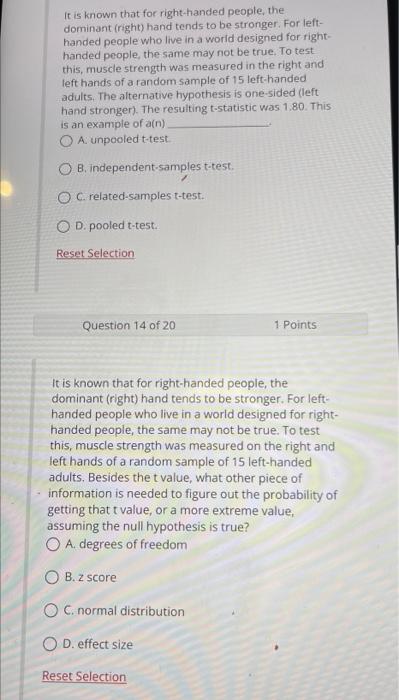
It is known that for right-handed people, the dominant (right) hand tends to be stronger. For left- handed people who live in a world designed for right- handed people, the same may not be true. To test this, muscle strength was measured in the right and left hands of a random sample of 15 left-handed adults. The alternative hypothesis is one-sided (left hand stronger). The resulting t-statistic was 1.80. This is an example of an O A unpooled t-test O B. independent samples t-test. O C. related samples t-test. OD. pooled t-test. Reset Selection Question 14 of 20 1 Points It is known that for right-handed people, the dominant (right) hand tends to be stronger. For left- handed people who live in a world designed for right- handed people, the same may not be true. To test this, muscle strength was measured on the right and left hands of a random sample of 15 left-handed adults. Besides the t value, what other piece of information is needed to figure out the probability of getting that value, or a more extreme value, assuming the null hypothesis is true? A degrees of freedom O B.2 score OC. normal distribution O D. effect size Reset Selection