Page 1 of 1
1. Credible Punishment or Repeated Cooperation. Recall that in the problem set 6, we described two factories that can ei
Posted: Wed May 11, 2022 10:11 am
by answerhappygod
- 1 Credible Punishment Or Repeated Cooperation Recall That In The Problem Set 6 We Described Two Factories That Can Ei 1 (217.59 KiB) Viewed 17 times
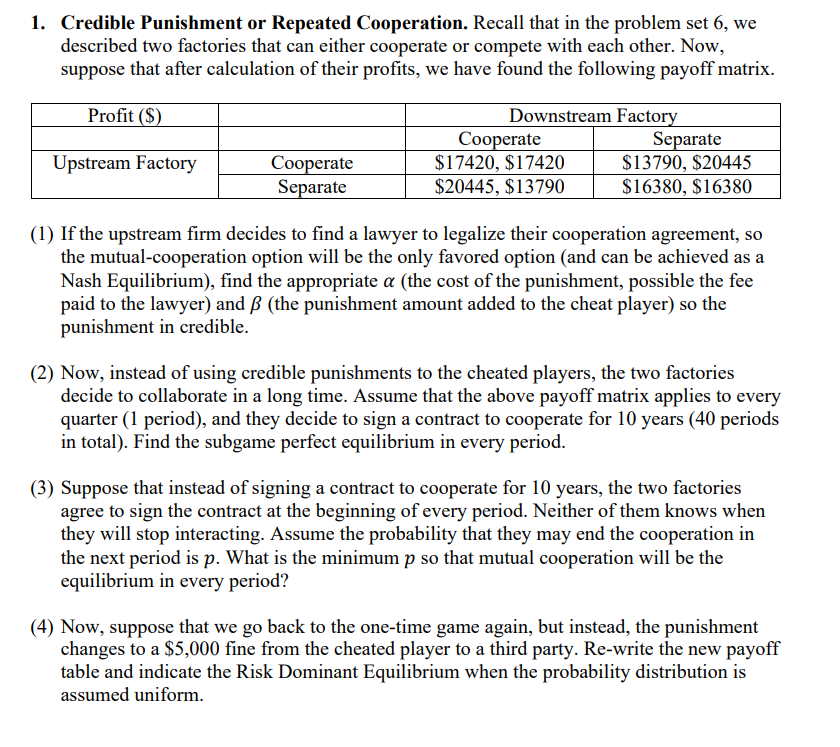
1. Credible Punishment or Repeated Cooperation. Recall that in the problem set 6, we described two factories that can either cooperate or compete with each other. Now, suppose that after calculation of their profits, we have found the following payoff matrix. Profit ($) Downstream Factory Cooperate Separate $17420, $17420 $13790, $20445 $20445, $13790 $16380, $16380 Upstream Factory Cooperate Separate (1) If the upstream firm decides to find a lawyer to legalize their cooperation agreement, so the mutual-cooperation option will be the only favored option (and can be achieved as a Nash Equilibrium), find the appropriate a (the cost of the punishment, possible the fee paid to the lawyer) and ß (the punishment amount added to the cheat player) so the punishment in credible. (2) Now, instead of using credible punishments to the cheated players, the two factories decide to collaborate in a long time. Assume that the above payoff matrix applies to every quarter (1 period), and they decide to sign a contract to cooperate for 10 years (40 periods in total). Find the subgame perfect equilibrium in every period. (3) Suppose that instead of signing a contract to cooperate for 10 years, the two factories agree to sign the contract at the beginning of every period. Neither of them knows when they will stop interacting. Assume the probability that they may end the cooperation in the next period is p. What is the minimum p so that mutual cooperation will be the equilibrium in every period? (4) Now, suppose that we go back to the one-time game again, but instead, the punishment changes to a $5,000 fine from the cheated player to a third party. Re-write the new payoff table and indicate the Risk Dominant Equilibrium when the probability distribution is assumed uniform.