Page 1 of 1
Data Analysis #3: SP 2022 Part 1: Introduction to ANOVAS In general, an ANOVA is conducted to assess whether means on a
Posted: Wed May 11, 2022 7:55 am
by answerhappygod
- Data Analysis 3 Sp 2022 Part 1 Introduction To Anovas In General An Anova Is Conducted To Assess Whether Means On A 1 (58.73 KiB) Viewed 28 times
- Data Analysis 3 Sp 2022 Part 1 Introduction To Anovas In General An Anova Is Conducted To Assess Whether Means On A 2 (55.09 KiB) Viewed 28 times
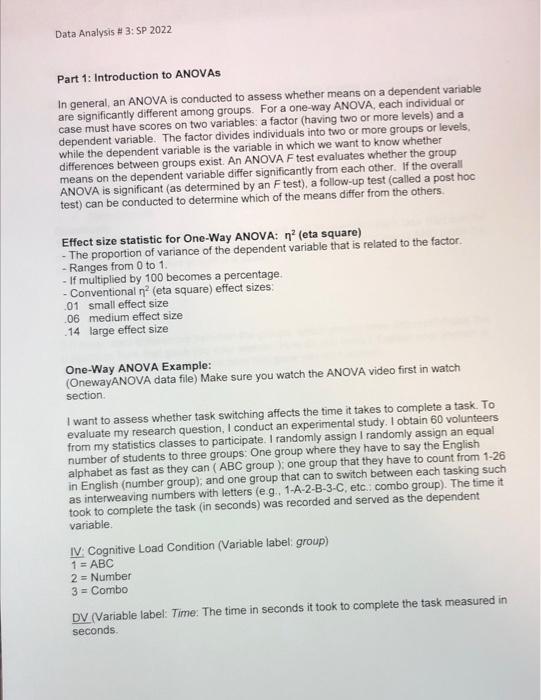
Data Analysis #3: SP 2022 Part 1: Introduction to ANOVAS In general, an ANOVA is conducted to assess whether means on a dependent variable are significantly different among groups. For a one-way ANOVA, each individual or case must have scores on two variables: a factor (having two or more levels) and a dependent variable. The factor divides individuals into two or more groups or levels, while the dependent variable is the variable in which we want to know whether differences between groups exist. An ANOVA F test evaluates whether the group means on the dependent variable differ significantly from each other. If the overall ANOVA is significant (as determined by an F test), a follow-up test (called a post hoc test) can be conducted to determine which of the means differ from the others Effect size statistic for One-way ANOVA: n (eta square) - The proportion of variance of the dependent variable that is related to the factor - Ranges from 0 to 1 - If multiplied by 100 becomes a percentage - Conventional na (eta square) effect sizes .01 small effect size .06 medium effect size .14 large effect size One-Way ANOVA Example: (OnewayANOVA data file) Make sure you watch the ANOVA video first in watch section I want to assess whether task switching affects the time it takes to complete a task. To evaluate my research question, I conduct an experimental study. I obtain 60 volunteers from my statistics classes to participate. I randomly assign I randomly assign an equal number of students to three groups. One group where they have to say the English alphabet as fast as they can (ABC group ): one group that they have to count from 1-26 in English (number group), and one group that can to switch between each tasking such as interweaving numbers with letters (eg. 1-A-2-B-3-C, etc.: combo group). The time it took to complete the task (in seconds) was recorded and served as the dependent variable IV: Cognitive Load Condition (Variable label group) 1 = ABC 2 = Number 3 = Combo DV (Variable label: Time: The time in seconds it took to complete the task measured in seconds
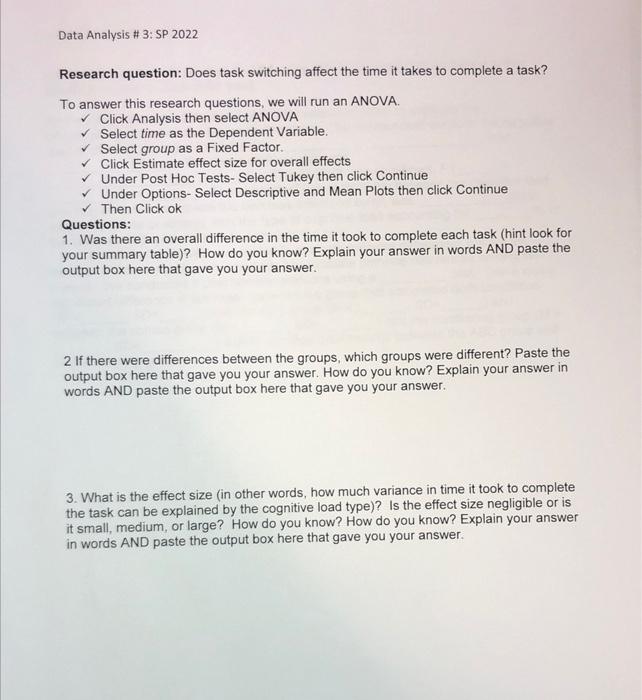
Data Analysis # 3: SP 2022 Research question: Does task switching affect the time it takes to complete a task? To answer this research questions, we will run an ANOVA. Click Analysis then select ANOVA Select time as the Dependent Variable. Select group as a Fixed Factor. Click Estimate effect size for overall effects ✓ Under Post Hoc Tests- Select Tukey then click Continue Under Options- Select Descriptive and Mean Plots then click Continue ✓ Then Click ok Questions: 1. Was there an overall difference in the time it took to complete each task (hint look for your summary table)? How do you know? Explain your answer in words AND paste the output box here that gave you your answer. 2 If there were differences between the groups, which groups were different? Paste the output box here that gave you your answer. How do you know? Explain your answer in words AND paste the output box here that gave you your answer. 3. What is the effect size (in other words, how much variance in time it took to complete the task can be explained by the cognitive load type)? Is the effect size negligible or is it small, medium, or large? How do you know? How do you know? Explain your answer in words AND paste the output box here that gave you your answer.