Page 1 of 1
Do lizards play a role in spreading plant seeds? Some research carried out in a country would suggest so. The researcher
Posted: Wed May 11, 2022 7:11 am
by answerhappygod
- Do Lizards Play A Role In Spreading Plant Seeds Some Research Carried Out In A Country Would Suggest So The Researcher 1 (95.87 KiB) Viewed 25 times
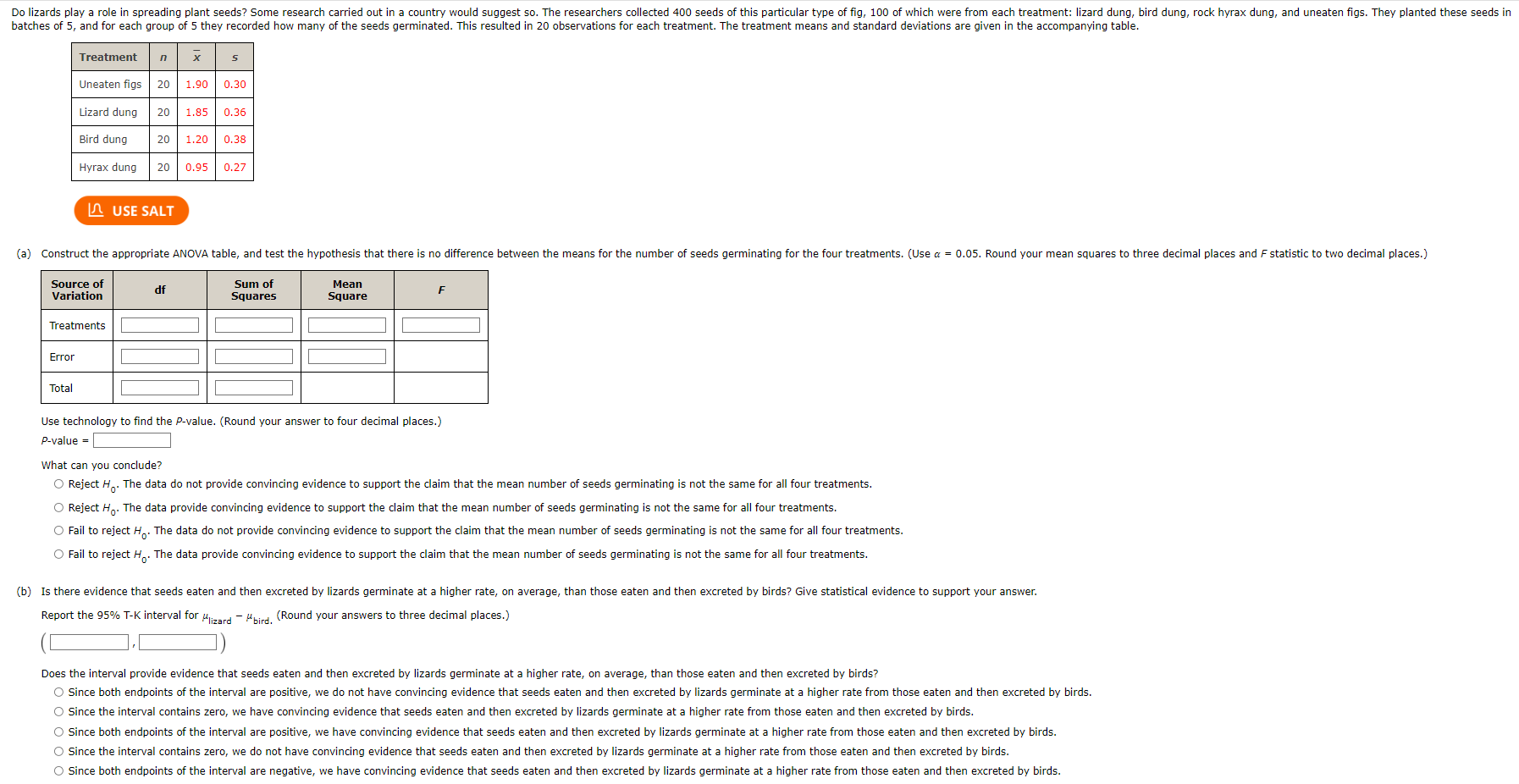
Do lizards play a role in spreading plant seeds? Some research carried out in a country would suggest so. The researchers collected 400 seeds of this particular type of fig, 100 of which were from each treatment: lizard dung, bird dung, rock hyrax dung, and uneaten figs. They planted these seeds in batches of 5, and for each group of 5 they recorded how many of the seeds germinated. This resulted in 20 observations for each treatment. The treatment means and standard deviations are given in the accompanying table. Treatment n x s Uneaten figs 20 1.90 0.30 Lizard dung 20 1.85 0.36 Bird dung 20 1.20 0.38 Hyrax dung 20 0.95 0.27 in USE SALT (a) Construct the appropriate ANOVA table, and test the hypothesis that there is no difference between the means for the number of seeds germinating for the four treatments. (Use a = 0.05. Round your mean squares to three decimal places and F statistic to two decimal places.) Source of Variation df Sum of Squares Mean Square F Treatments Error Total Use technology to find the P-value. (Round your answer to four decimal places.) P-value = What can you conclude? Reject H. The data do not provide convincing evidence to support the claim that the mean number of seeds germinating is not the same for all four treatments. O Reject Ho. The data provide convincing evidence to support the claim that the mean number of seeds germinating is not the same for all four treatments. O Fail to reject Ho. The data do not provide convincing evidence to support the claim that the mean number of seeds germinating is not the same for all four treatments. Fail to reject Ho. The data provide convincing evidence to support the claim that the mean number of seeds germinating is not the same for all four treatments. (b) Is there evidence that seeds eaten and then excreted by lizards germinate at a higher rate, on average, than those eaten and then excreted by birds? Give statistical evidence to support your answer. Report the 95% T-K interval for Mizard - "bird. (Round your answers to three decimal places.) Does the interval provide evidence that seeds eaten and then excreted by lizards germinate at a higher rate, on average, than those eaten and then excreted by birds? Since both endpoints of the interval are positive, we do not have convincing evidence that seeds eaten and then excreted by lizards germinate at a higher rate from those eaten and then excreted by birds. Since the interval contains zero, we have convincing evidence that seeds eaten and then excreted by lizards germinate at a higher rate from those eaten and then excreted by birds. O Since both endpoints of the interval are positive, we have convincing evidence that seeds eaten and then excreted by lizards germinate at a higher rate from those eaten and then excreted by birds. Since the interval contains zero, we do not have convincing evidence that seeds eaten and then excreted by lizards germinate at a higher rate from those eaten and then excreted by birds. Since both endpoints of the interval are negative, we have convincing evidence that seeds eaten and then excreted by lizards germinate at a higher rate from those eaten and then excreted by birds.