Page 1 of 1
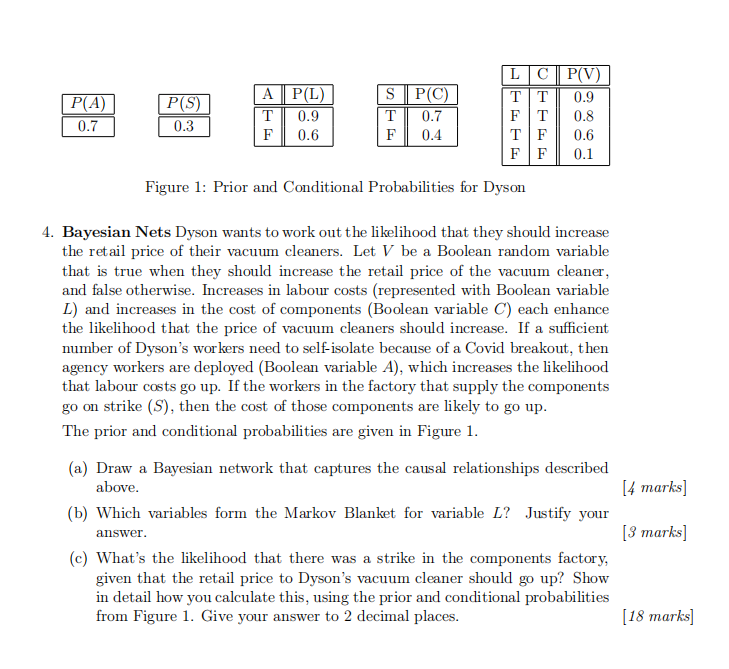
P(A) 0.7 P(S) 0.3 A P(L) T F 0.6 0.9 SPC) T 0.7 F 0.4 LCP(V) ΤΙΤ 0.9 FT 0.8 TF 0.6 FF 0.1 Figure 1: Prior and Conditiona
Posted: Wed May 11, 2022 6:26 am
by answerhappygod
- 1 (104.78 KiB) Viewed 38 times
P(A) 0.7 P(S) 0.3 A P(L) T F 0.6 0.9 SPC) T 0.7 F 0.4 LCP(V) ΤΙΤ 0.9 FT 0.8 TF 0.6 FF 0.1 Figure 1: Prior and Conditional Probabilities for Dyson 4. Bayesian Nets Dyson wants to work out the likelihood that they should increase the retail price of their vacuum cleaners. Let V be a Boolean random variable that is true when they should increase the retail price of the vacuum cleaner, and false otherwise. Increases in labour costs (represented with Boolean variable L) and increases in the cost of components (Boolean variable C) each enhance the likelihood that the price of vacuum cleaners should increase. If a sufficient number of Dyson's workers need to self-isolate because of a Covid breakout, then agency workers are deployed (Boolean variable A), which increases the likelihood that labour costs go up. If the workers in the factory that supply the components go on strike (S), then the cost of those components are likely to go up. The prior and conditional probabilities are given in Figure 1. (a) Draw a Bayesian network that captures the causal relationships described above. (b) Which variables form the Markov Blanket for variable L? Justify your answer. (C) What's the likelihood that there was a strike in the components factory, given that the retail price to Dyson's vacuum cleaner should go up? Show in detail how you calculate this, using the prior and conditional probabilities from Figure 1. Give your answer to 2 decimal places. [4 marks] [3 marks] [18 marks]