Page 1 of 1
The mitochondrial enzyme NAPH:NAD transhydrogenase of the common rat tapeworm (Hymenolegsis diminuta) catalyzes hydrogen
Posted: Wed May 11, 2022 6:02 am
by answerhappygod
- The Mitochondrial Enzyme Naph Nad Transhydrogenase Of The Common Rat Tapeworm Hymenolegsis Diminuta Catalyzes Hydrogen 1 (95.29 KiB) Viewed 17 times
- The Mitochondrial Enzyme Naph Nad Transhydrogenase Of The Common Rat Tapeworm Hymenolegsis Diminuta Catalyzes Hydrogen 2 (22.83 KiB) Viewed 17 times
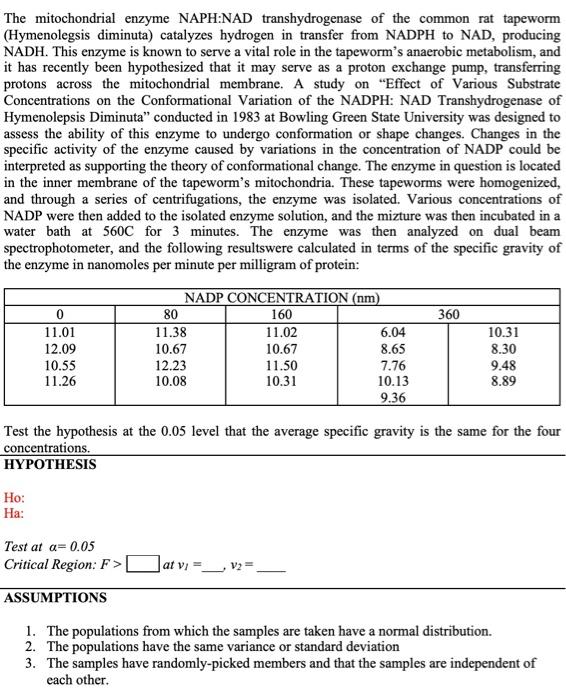
The mitochondrial enzyme NAPH:NAD transhydrogenase of the common rat tapeworm (Hymenolegsis diminuta) catalyzes hydrogen in transfer from NADPH to NAD, producing NADH. This enzyme is known to serve a vital role in the tapeworm's anaerobic metabolism, and it has recently been hypothesized that it may serve as a proton exchange pump, transferring protons across the mitochondrial membrane. A study on "Effect of Various Substrate Concentrations on the Conformational Variation of the NADPH: NAD Transhydrogenase of Hymenolepsis Diminuta" conducted in 1983 at Bowling Green State University was designed to assess the ability of this enzyme to undergo conformation or shape changes. Changes in the specific activity of the enzyme caused by variations in the concentration of NADP could be interpreted as supporting the theory of conformational change. The enzyme in question is located in the inner membrane of the tapeworm's mitochondria. These tapeworms were homogenized, and through a series of centrifugations, the enzyme was isolated. Various concentrations of NADP were then added to the isolated enzyme solution, and the mizture was then incubated in a water bath at 560C for 3 minutes. The enzyme was then analyzed on dual beam spectrophotometer, and the following resultswere calculated in terms of the specific gravity of the enzyme in nanomoles per minute per milligram of protein: 80 360 0 11.01 12.09 10.55 11.26 NADP CONCENTRATION (nm) 160 11.38 11.02 6.04 10.67 10.67 8.65 12.23 11.50 7.76 10.08 10.31 10.13 9.36 10.31 8.30 9.48 8.89 Test the hypothesis at the 0.05 level that the average specific gravity is the same for the four concentrations. HYPOTHESIS Ho: Ha: Test at a=0.05 Critical Region: F at vi V2 ASSUMPTIONS 1. The populations from which the samples are taken have a normal distribution. 2. The populations have the same variance or standard deviation 3. The samples have randomly-picked members and that the samples are independent of each other.
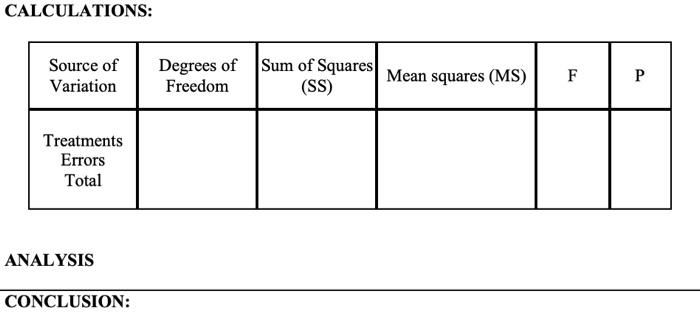
CALCULATIONS: Source of Variation Degrees of Sum of Squares Freedom (SS) Mean squares (MS) F P Treatments Errors Total ANALYSIS CONCLUSION: