Page 1 of 1
Course Code 科目編號: ECON3121AB *(#T) Page 4 of 5 Questions 4 (Total 20 points) Consider the saving function, sav; = Bo + B
Posted: Wed May 11, 2022 5:56 am
by answerhappygod
- 1 (93.43 KiB) Viewed 18 times
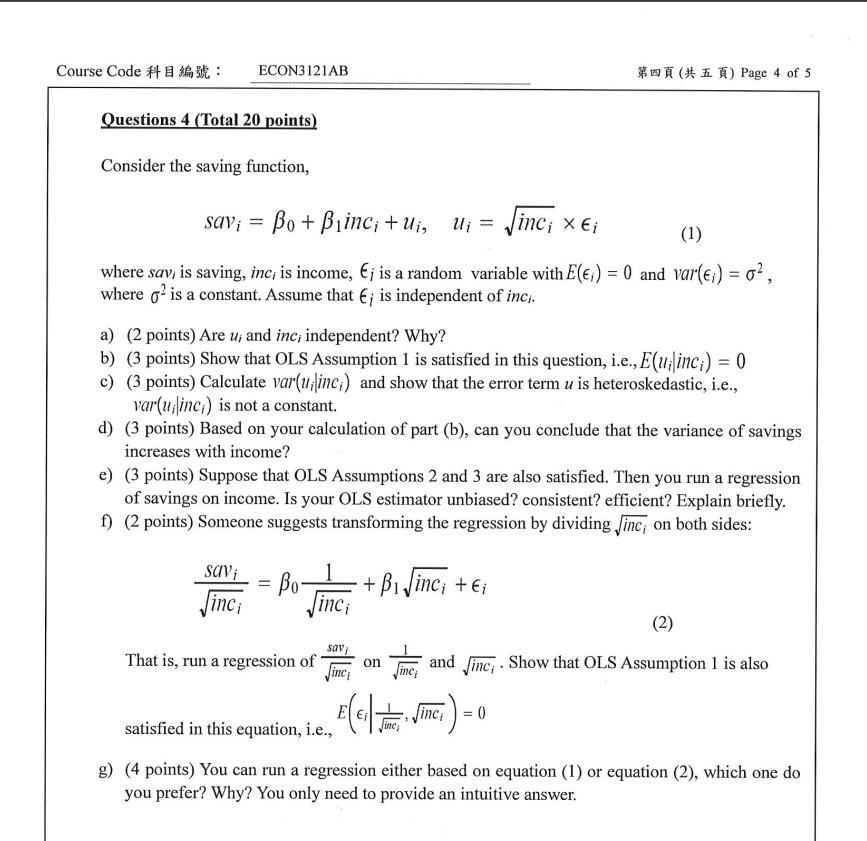
Course Code 科目編號: ECON3121AB *(#T) Page 4 of 5 Questions 4 (Total 20 points) Consider the saving function, sav; = Bo + Biinc; + ui, = Ui = Vinc; xei (1) - where sav, is saving, inc; is income, Ej is a random variable with E(ei) = 0 and var(ei) = 02, where o2 is a constant. Assume that €; is independent of inc). a) (2 points) Are u; and inc; independent? Why? b) (3 points) Show that OLS Assumption 1 is satisfied in this question, i.e., E(u\inci) = 0 c) (3 points) Calculate var(ui\inci) and show that the error term u is heteroskedastic, i.e., var(uinci) is not a constant. d) (3 points) Based on your calculation of part (b), can you conclude that the variance of savings increases with income? e) (3 points) Suppose that OLS Assumptions 2 and 3 are also satisfied. Then you run a regression of savings on income. Is your OLS estimator unbiased? consistent? efficient? Explain briefly. f) (2 points) Someone suggests transforming the regression by dividing inc; on both sides: Savi inci Bo Vinc + B1 inci + Ei (2) Sav on line That is, run a regression of inct and inc;. Show that OLS Assumption 1 is also ECE Singi = 0 satisfied in this equation, i.e., g) (4 points) You can run a regression either based on equation (1) or equation (2), which one do you prefer? Why? You only need to provide an intuitive answer.