Page 1 of 1
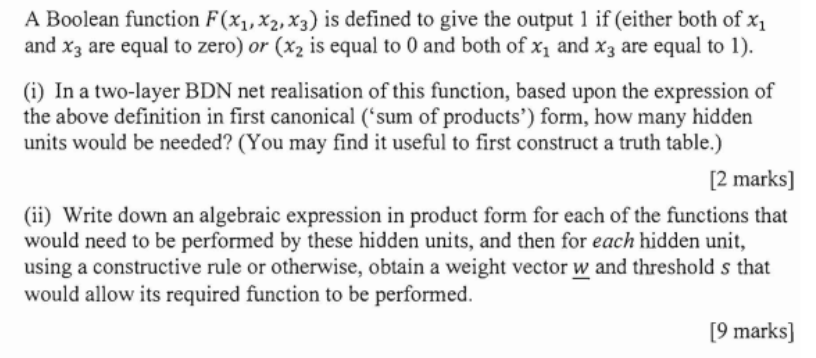
A Boolean function F(X1, X2, X3) is defined to give the output 1 if (either both of xı and Xz are equal to zero) or (X2
Posted: Tue May 10, 2022 6:35 pm
by answerhappygod
- A Boolean Function F X1 X2 X3 Is Defined To Give The Output 1 If Either Both Of Xi And Xz Are Equal To Zero Or X2 1 (150.23 KiB) Viewed 24 times
A Boolean function F(X1, X2, X3) is defined to give the output 1 if (either both of xı and Xz are equal to zero) or (X2 is equal to 0 and both of xy and X3 are equal to 1). (i) In a two-layer BDN net realisation of this function, based upon the expression of the above definition in first canonical (* sum of products") form, how many hidden units would be needed? (You may find it useful to first construct a truth table.) [2 marks] (ii) Write down an algebraic expression in product form for each of the functions that would need to be performed by these hidden units, and then for each hidden unit, using a constructive rule or otherwise, obtain a weight vector w and threshold s that would allow its required function to be performed. [9 marks]