Page 1 of 1
= = Consider the NLLS problem below: fit a model with four parameters (n = 4) of the form m(t) = 11e-22+ 13e –14t to a g
Posted: Tue May 10, 2022 7:19 am
by answerhappygod
- Consider The Nlls Problem Below Fit A Model With Four Parameters N 4 Of The Form M T 11e 22 13e 14t To A G 1 (91.6 KiB) Viewed 30 times
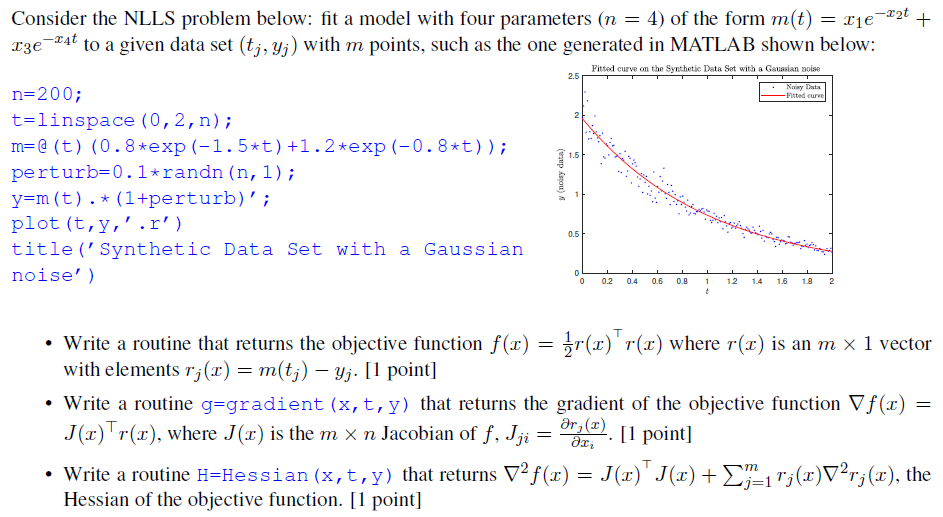
= = Consider the NLLS problem below: fit a model with four parameters (n = 4) of the form m(t) = 11e-22+ 13e –14t to a given data set (tj, Yj) with m points, such as the one generated in MATLAB shown below: 2.5 Fitted curve on the Synthetic Data Set with a Gaussian noise Norway Date tad curve 2 1.5 n=200; t=linspace (0,2, n); m=@ (t) (0.8*exp(-1.5*t) +1.2 *exp(-0.8*t)); perturb=0.1*randn (n,1); y=m(t).*(1+perturb)'; plot (t,y,'.r') title(' Synthetic Data Set with a Gaussian noise) y noisy data) 0.5 0 0 0.2 0.4 0.6 0.8 12 1.4 1.6 1.8 2 1 t = = = • Write a routine that returns the objective function f(x) = žr(r)"r(r) where r(e) is an m x 1 vector with elements rj(x) = m(tj) - Yj. [1 point] • Write a routine grgradient (x, t,y) that returns the gradient of the objective function Vf(1) მr (1) J(1) Tr(I), where J(:) is the m x n Jacobian of f, Jji [1 point] • Write a routine H=Hessian(x,t,y) that returns 02 f(t) = J()"J(1) + =1 "j(x)D2r;(I), the Hessian of the objective function. [1 point] = ar, . =