Page 1 of 1
12 Zum va 1 40 12 1) The velocity of a mass is increased 4 times the kinetic energy is increased a) 16 times b) 4 times
Posted: Mon May 09, 2022 6:06 pm
by answerhappygod
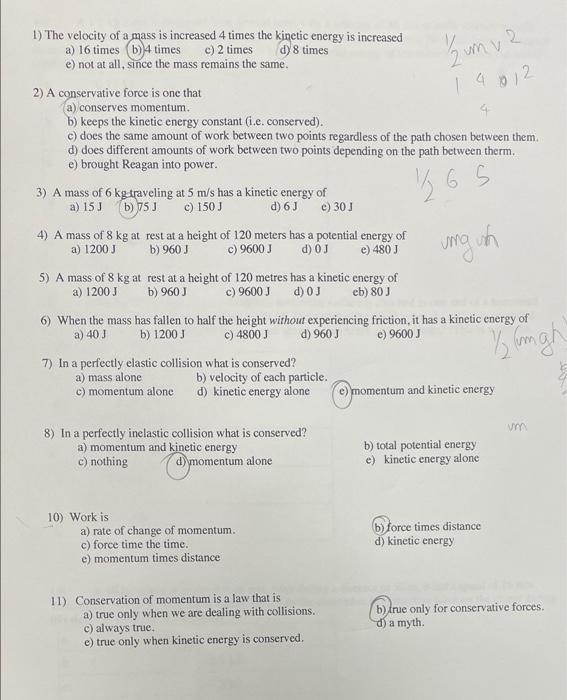
- 12 Zum Va 1 40 12 1 The Velocity Of A Mass Is Increased 4 Times The Kinetic Energy Is Increased A 16 Times B 4 Times 1 (55.56 KiB) Viewed 24 times
12 Zum va 1 40 12 1) The velocity of a mass is increased 4 times the kinetic energy is increased a) 16 times b) 4 times c) 2 times d) 8 times e) not at all, since the mass remains the same. 2) A conservative force is one that a) conserves momentum. b) keeps the kinetic energy constant (i.e. conserved). c) does the same amount of work between two points regardless of the path chosen between them. d) does different amounts of work between two points depending on the path between therm e) brought Reagan into power. 65 3) A mass of 6 kg traveling at 5 m/s has a kinetic energy of a) 15J b) 95J C) 150J d) 6J C) 301 4) A mass of 8 kg at rest at a height of 120 meters has a potential energy of a) 1200 b) 960 c) 9600J d) OJ e) 480) 5) A mass of 8 kg at rest at a height of 120 metres has a kinetic energy of a) 1200 b) 960J c) 9600J d) 0J cb) 80J 6) When the mass has fallen to half the height without experiencing friction, it has a kinetic energy of a) 40J b) 1200J c) 4800 d) 960J e) 9600 7) In a perfectly elastic collision what is conserved? a) mass alone b) velocity of each particle. c) momentum alone d) kinetic energy alone e) momentum and kinetic energy ungush V lmgh WY 8) In a perfectly inelastic collision what is conserved? a) momentum and kinetic energy c) nothing d)momentum alone b) total potential energy e) kinetic energy alone 10) Work is a) rate of change of momentum. c) force time the time. e) momentum times distance b) force times distance d) kinetic energy 11) Conservation of momentum is a law that is a) true only when we are dealing with collisions. c) always true e) true only when kinetic energy is conserved. b) true only for conservative forces. d) a myth.