- Can Somesome Calculate How Large In Grams Is The Theoretical Yield This Compound Contains One 11 8 Bond Between 1 (44.06 KiB) Viewed 21 times
- Can Somesome Calculate How Large In Grams Is The Theoretical Yield This Compound Contains One 11 8 Bond Between 2 (38.53 KiB) Viewed 21 times
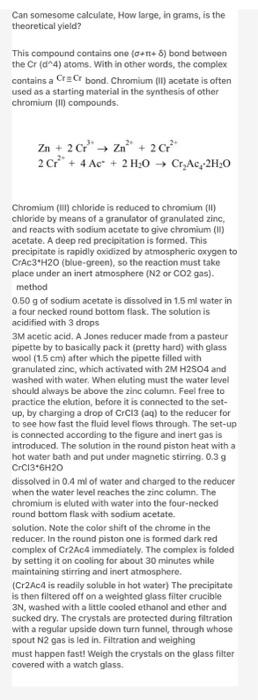
Can somesome calculate, How large, in grams, is the theoretical yield? This compound contains one (+11+ 8) bond between the Cr (d^4) atoms. With in other words, the complex contains a Crect bond. Chromium (1) acetate is often used as a starting material in the synthesis of other chromium (m) compounds. Zn + 2C" → Zn + 2 Cr? 27" + 4 Ac + 2H30 Cr Ac, 2H:0 Chromium() chloride is reduced to chromium (II) chloride by means of a granulator of granulated zinc, and reacts with sodium acetate to give chromium () acetate. A deep red precipitation is formed. This precipitate is rapidly oxidized by atmospheric oxygen to CrAc3*H20 (blue-green), so the reaction must take place under an inert atmosphere (N2 or CO2 gas). method 0.50 g of sodium acetate is dissolved in 1.5 ml water in a four necked round bottom flask. The solution is acidified with 3 drops 3M acetic acid. A Jones reducer made from a pasteur pipette by to basically pack it (pretty hard) with glass wool (1.5 cm) after which the pipette filled with granulated zine, which activated with 2M H2SO4 and washed with water. When eluting must the water level should always be above the zinc column. Feel free to practice the elution, before it is connected to the set- up, by charging a drop of CHCl3 (aq) to the reducer for to see how fast the fluid level flows through. The set-up is connected according to the figure and inert gas is introduced. The solution in the round piston heat with a hot water bath and put under magnetic stirring. 0.39 CrC136H20 dissolved in 0.4 ml of water and charged to the reducer when the water level reaches the zinc column. The chromium is eluted with water into the four-necked round bottom flask with sodium acetate. solution. Note the color shift of the chrome in the reducer. In the round piston one is formed dark red complex of Cr2Ac4 immediately. The complex is folded by setting it on cooling for about 30 minutes while maintaining stirring and inert atmosphere. (Cr2Act is readily soluble in hot water) The precipitate is then filtered off on a weighted glass filter crucible 3N, washed with a little cooled ethanol and other and sucked dry. The crystals are protected during filtration with a regular upside downturn funnel, through whose spout N2 gas is led in. Filtration and weighing must happen fast! Weigh the crystals on the glass filter covered with a watch glass.
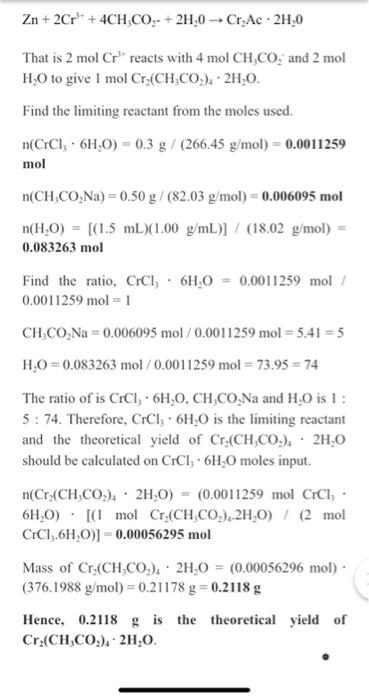
Zn + 2Cr + 4CH CO.,- + 2H,0 - CrAc - 240 That is 2 mol Cr reacts with 4 mol CH.CO, and 2 mol H 0 to give 1 mol Cr:(CH,CO2) 24-0. Find the limiting reactant from the moles used. n(CrCI, 6H,0) = 0.3 g/ (266.45 g/mol) = 0.0011259 mol n(CH.CO.Na)=0.50 g/(82.03 g/mol) = 0.006095 mol n(H.0) = [(1.5 mL)(1.00 g/mL)] / (18.02 g/mol) 0.083263 mol Find the ratio, CCI, 6H,0 = 0.0011259 mol/ 0.0011259 mol = 1 CH CO Na = 0.006095 mol/0.0011259 mol = 5.41 = 5 H.0 = 0.083263 mol/0.0011259 mol = 73.95 = 74 The ratio of is CCI, 6H-0, CH.CO.Na and H0 is 1 : 5: 74. Therefore, CHCI, 6H_0 is the limiting reactant and the theoretical yield of Cr:(CH,CO2): 2H.0 should be calculated on CCI, 6H-0 moles input. n(Cr-(CHCO:). 24,0) - (0.0011259 mol CrCI, 61,0) [(1 mol Cr(CH,CO2), 2H.0) (2 mol CHCI,.6H,0)) = 0.00056295 mol Mass of Cr,(CH.CO.). - 24,0 = (0.00056296 mol). (376.1988 g/mol) = 0.21178 g = 0.2118 g Hence, 0.2118 is the theoretical yield of Cry(CH,CO2).- 2H,0. -