Page 1 of 1
0.3 Consider the reflection of light at hear normal incidence from a glass surface coated with a thin film, as illustrat
Posted: Mon May 09, 2022 2:32 pm
by answerhappygod
- 0 3 Consider The Reflection Of Light At Hear Normal Incidence From A Glass Surface Coated With A Thin Film As Illustrat 1 (43.94 KiB) Viewed 21 times
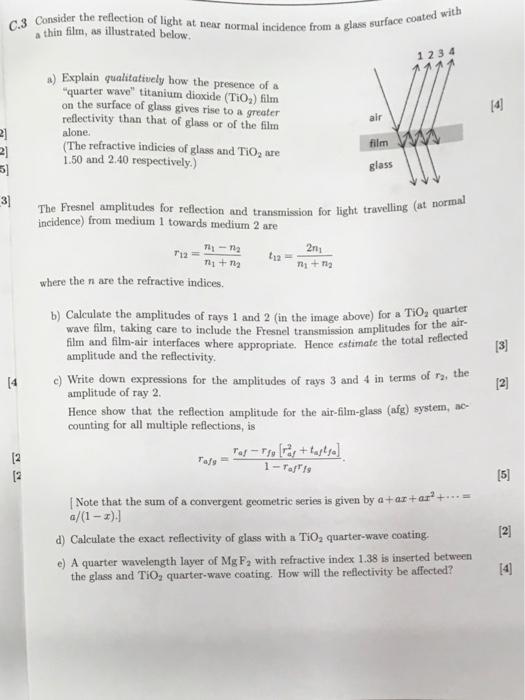
0.3 Consider the reflection of light at hear normal incidence from a glass surface coated with a thin film, as illustrated below. *) Explain qualitatively how the presence of a "quarter wave" titanium dioxide (T10,) film on the surface of glass gives rise to a greater reflectivity than that of glass or of the film alone. (The refractive indicies of glass and To, are 1.50 and 2.40 respectively.) alr film 21 2) 51 glass 3) incidence) frotn medium 1 towards medium 2 are The Fresnel amplitudes for reflection and transmission for light travelling (at normal Th: - 2n '12 112 + mi +12 where the n are the refractive indices. b) Calculate the amplitudes of rays 1 and 2 (in the image above) for a Ti0, quarter wave film, taking care to include the Fresnel transmission amplitudes for the air film and film-air interfaces where appropriate. Hence estimate the total reflected amplitude and the reflectivity, c) Write down expressions for the amplitudes of rays 3 and 4 in terms of ry, the amplitude of ray 2. Hence show that the reflection amplitude for the air-film-glass (afg) system, counting for all multiple reflections, is Tasts [Par+fasts] 1-Tarts [3] 14 [2] Tate 12 12 [5] [2] Note that the sum of a convergent geometric series is given by a+ar+ar a/(1 - 1). d) Calculate the exact reflectivity of glass with a TiO2 quarter-wave coating e) A quarter wavelength layer of Mg F, with refractive index 1.38 is inserted between the glass and Ti0, quarter-wave coating. How will the reflectivity be affected?