Page 1 of 1
1. (DUE ON THURSDAY - not graded but will be solved together in class and I will check that you have done it) Hydrogen h
Posted: Mon May 09, 2022 2:29 pm
by answerhappygod
- 1 Due On Thursday Not Graded But Will Be Solved Together In Class And I Will Check That You Have Done It Hydrogen H 1 (227.86 KiB) Viewed 18 times
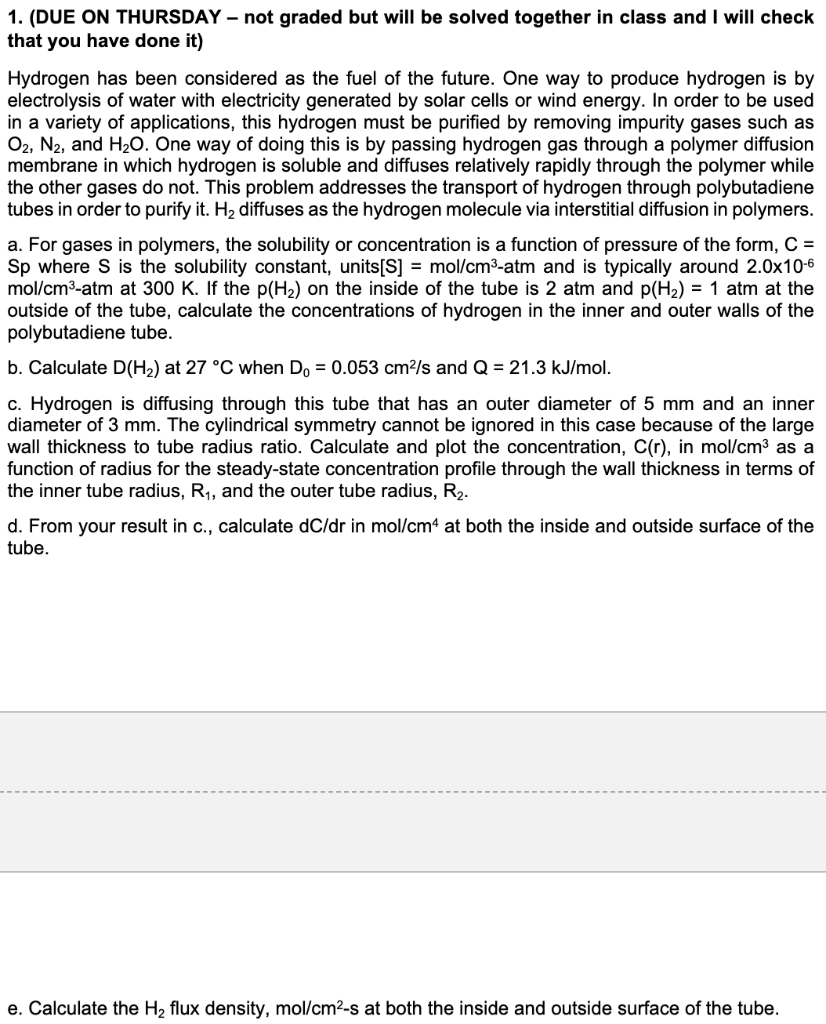
1. (DUE ON THURSDAY - not graded but will be solved together in class and I will check that you have done it) Hydrogen has been considered as the fuel of the future. One way to produce hydrogen is by electrolysis of water with electricity generated by solar cells or wind energy. In order to be used in a variety of applications, this hydrogen must be purified by removing impurity gases such as O2, N2, and H20. One way of doing this is by passing hydrogen gas through a polymer diffusion membrane in which hydrogen is soluble and diffuses relatively rapidly through the polymer while the other gases do not. This problem addresses the transport of hydrogen through polybutadiene tubes in order to purify it. Hz diffuses as the hydrogen molecule via interstitial diffusion in polymers. a. For gases in polymers, the solubility or concentration is a function of pressure of the form, C = Sp where S is the solubility constant, units[S] = mol/cm3-atm and is typically around 2.0x10⁻⁶ mol/cm3-atm at 300 K. If the p(Hz) on the inside of the tube is 2 atm and p(H2) = 1 atm at the outside of the tube, calculate the concentrations of hydrogen in the inner and outer walls of the polybutadiene tube. b. Calculate D(H2) at 27 °C when Do = 0.053 cm²/s and Q = 21.3 kJ/mol. c. Hydrogen is diffusing through this tube that has an outer diameter of 5 mm and an inner diameter of 3 mm. The cylindrical symmetry cannot be ignored in this case because of the large wall thickness to tube radius ratio. Calculate and plot the concentration, C(r), in mol/cm3 as a function of radius for the steady-state concentration profile through the wall thickness in terms of the inner tube radius, R1, and the outer tube radius, R2. d. From your result in c., calculate dC/dr in mol/cm4 at both the inside and outside surface of the tube. e. Calculate the H2 flux density, mol/cm2-s at both the inside and outside surface of the tube.