Page 1 of 1
Exercise 3, Lagrangian formalism and the Lennard-Jones potential (35pt) The relevant chapters from Taylor are chapters 6
Posted: Mon May 09, 2022 2:01 pm
by answerhappygod
- Exercise 3 Lagrangian Formalism And The Lennard Jones Potential 35pt The Relevant Chapters From Taylor Are Chapters 6 1 (420.05 KiB) Viewed 24 times
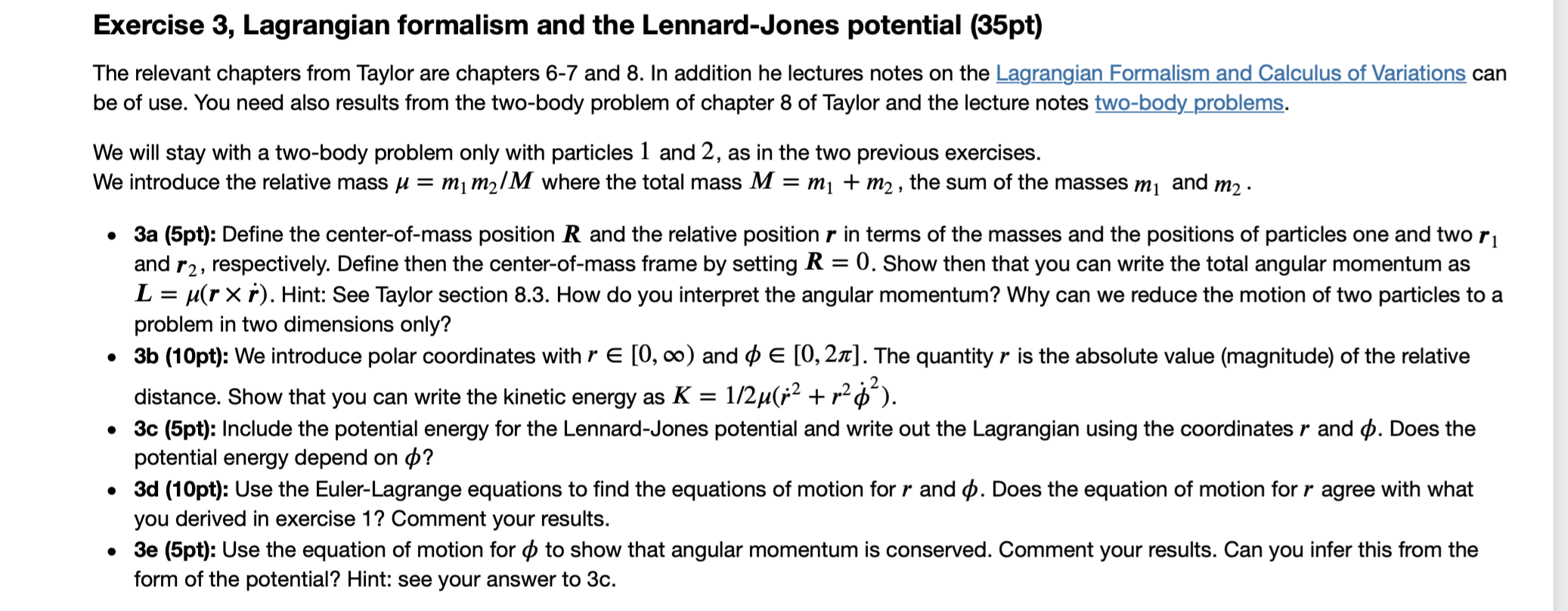
Exercise 3, Lagrangian formalism and the Lennard-Jones potential (35pt) The relevant chapters from Taylor are chapters 6-7 and 8. In addition he lectures notes on the Lagrangian Formalism and Calculus of Variations can be of use. You need also results from the two-body problem of chapter 8 of Taylor and the lecture notes two-body_problems. We will stay with a two-body problem only with particles 1 and 2, as in the two previous exercises. We introduce the relative mass u = mim2/M where the total mass M = mı + m2, the sum of the masses my and m2 - . = 3a (5pt): Define the center-of-mass position R and the relative position r in terms of the masses and the positions of particles one and two rı and r2, respectively. Define then the center-of-mass frame by setting R = 0. Show then that you can write the total angular momentum as L = u(r x r). Hint: See Taylor section 8.3. How do you interpret the angular momentum? Why can we reduce the motion of two particles to a problem in two dimensions only? • 3b (10pt): We introduce polar coordinates with r e [0,00) and € [0,21]. The quantity r is the absolute value (magnitude) of the relative distance. Show that you can write the kinetic energy as K = 1/2u(32 +r202). 3c (5pt): Include the potential energy for the Lennard-Jones potential and write out the Lagrangian using the coordinates r and 0. Does the potential energy depend on 0? • 3d (10pt): Use the Euler-Lagrange equations to find the equations of motion for r and $. Does the equation of motion for r agree with what you derived in exercise 1? Comment your results. • 3e (5pt): Use the equation of motion for $ to show that angular momentum is conserved. Comment your results. Can you infer this from the form of the potential? Hint: see your answer to 3c.