Page 1 of 1
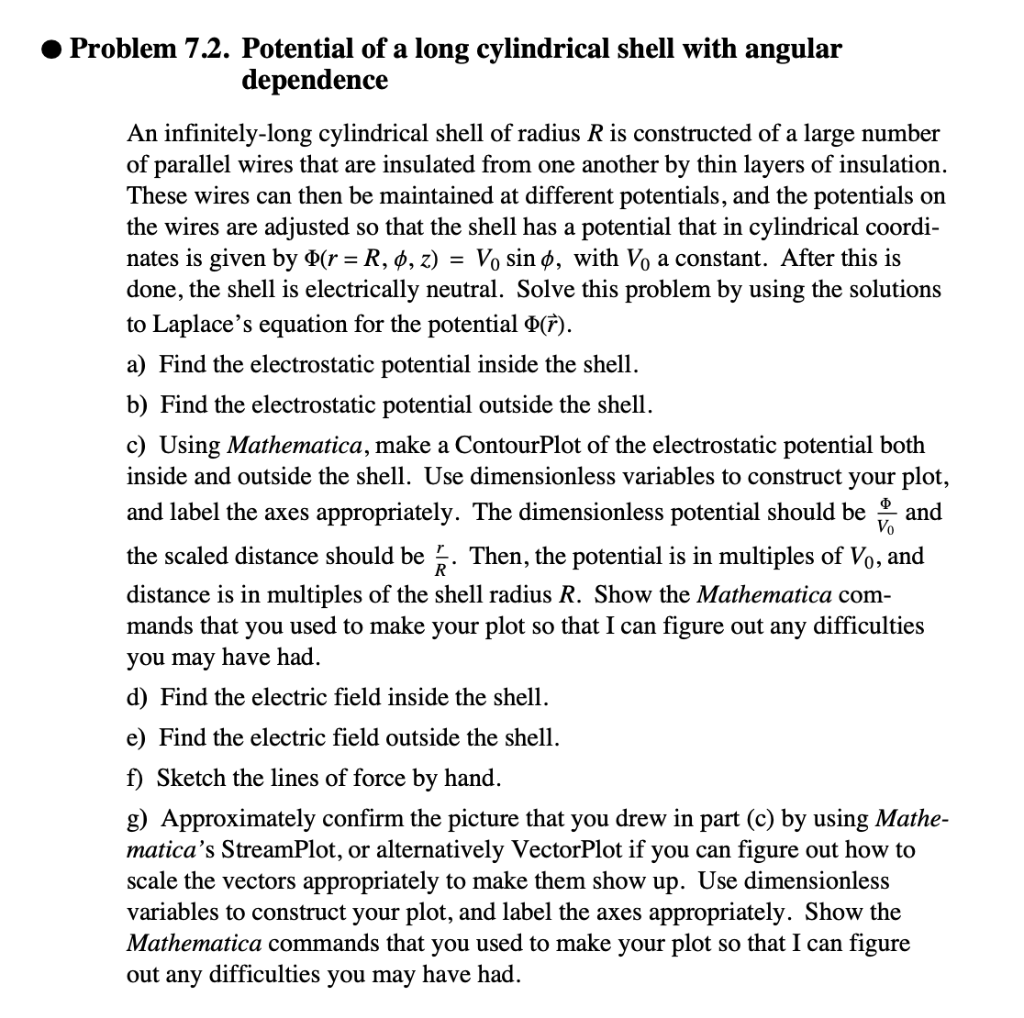
Problem 7.2. Potential of a long cylindrical shell with angular dependence = Vo An infinitely-long cylindrical shell of
Posted: Mon May 09, 2022 1:59 pm
by answerhappygod
- Problem 7 2 Potential Of A Long Cylindrical Shell With Angular Dependence Vo An Infinitely Long Cylindrical Shell Of 1 (319.68 KiB) Viewed 25 times
Problem 7.2. Potential of a long cylindrical shell with angular dependence = Vo An infinitely-long cylindrical shell of radius R is constructed of a large number of parallel wires that are insulated from one another by thin layers of insulation. These wires can then be maintained at different potentials, and the potentials on the wires are adjusted so that the shell has a potential that in cylindrical coordi- nates is given by ø(r = R, 0, z) = Vsin , with Vo a constant. After this is done, the shell is electrically neutral. Solve this problem by using the solutions to Laplace's equation for the potential o(). a) Find the electrostatic potential inside the shell. b) Find the electrostatic potential outside the shell. c) Using Mathematica, make a ContourPlot of the electrostatic potential both inside and outside the shell. Use dimensionless variables to construct your plot, and label the axes appropriately. The dimensionless potential should be and the scaled distance should be . Then, the potential is in multiples of Vo, and distance is in multiples of the shell radius R. Show the Mathematica com- mands that you used to make your plot so that I can figure out any difficulties you may have had. d) Find the electric field inside the shell. e) Find the electric field outside the shell. f) Sketch the lines of force by hand. g) Approximately confirm the picture that you drew in part (c) by using Mathe- matica's StreamPlot, or alternatively VectorPlot if you can figure out how to scale the vectors appropriately to make them show up. Use dimensionless variables to construct your plot, and label the axes appropriately. Show the Mathematica commands that you used to make your plot so that I can figure out any difficulties you may have had. R