Page 1 of 1
(b) You are using a CCD with a gain of 2 e/ADU, readout noise of 4 e/pixel rms, and responsive quantum efficiency of 70%
Posted: Mon May 09, 2022 1:44 pm
by answerhappygod
- B You Are Using A Ccd With A Gain Of 2 E Adu Readout Noise Of 4 E Pixel Rms And Responsive Quantum Efficiency Of 70 1 (49.94 KiB) Viewed 20 times
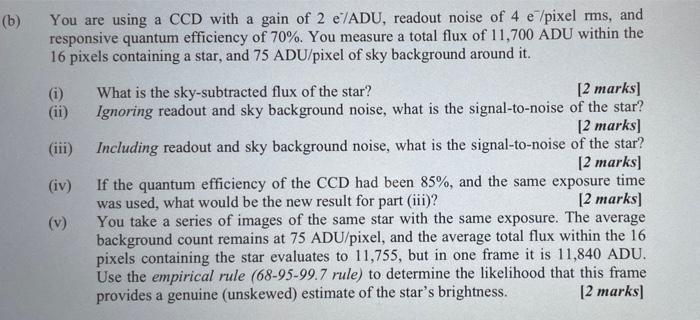
(b) You are using a CCD with a gain of 2 e/ADU, readout noise of 4 e/pixel rms, and responsive quantum efficiency of 70%. You measure a total flux of 11,700 ADU within the 16 pixels containing a star, and 75 ADU/pixel of sky background around it. (1) What is the sky-subtracted flux of the star? [2 marks] (ii) Ignoring readout and sky background noise, what is the signal-to-noise of the star? [2 marks] (iii) Including readout and sky background noise, what is the signal-to-noise of the star? [2 marks] (iv) If the quantum efficiency of the CCD had been 85%, and the same exposure time was used, what would be the new result for part (iii)? [2 marks] (v) You take a series of images of the same star with the same exposure. The average background count remains at 75 ADU/pixel, and the average total flux within the 16 pixels containing the star evaluates to 11,755, but in one frame it is 11,840 ADU. Use the empirical rule (68-95-99.7 rule) to determine the likelihood that this frame provides a genuine (unskewed) estimate of the star's brightness. [2 marks]