- 3 24 Marks An Ultrasound Examination Of A Patient With A Suspected Stenosed E Partially Occluded Vessel Identifi 1 (97.96 KiB) Viewed 31 times
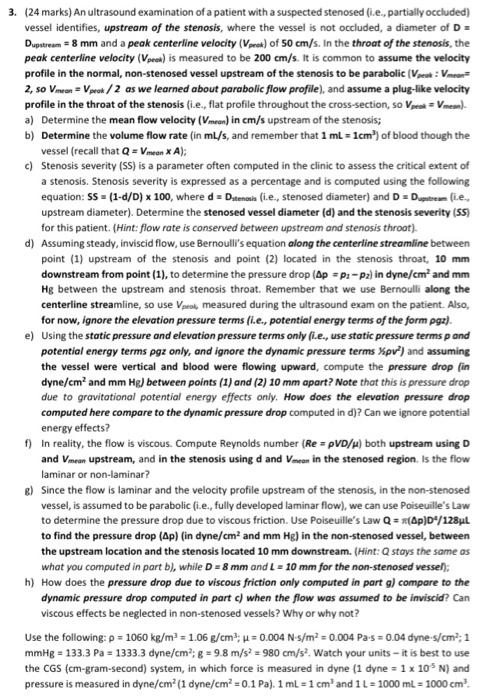
3. (24 marks) An ultrasound examination of a patient with a suspected stenosed (.e., partially occluded) vessel identifies, upstream of the stenosis, where the vessel is not occluded, a diameter of D = Dupstream = 8 mm and a peak centerline velocity (Vero) of 50 cm/s. In the throat of the stenosis, the peak centerline velocity (pro) is measured to be 200 cm/s. It is common to assume the velocity profile in the normal, non-stenosed vessel upstream of the stenosis to be parabolic (Vest : Vimeo 2, so Vimean = Vpok / 2 as we learned about parabolic flow profile), and assume a plug-like velocity profile in the throat of the stenosis (i.e., flat profile throughout the cross-section, so Ves =Vmes) a) Determine the mean flow velocity (Vmeen) in cm/s upstream of the stenosis; b) Determine the volume flow rate (in ml/s, and remember that 1 ml = 1cm) of blood though the vessel (recall that Q - Vnwan x A): c) Stenosis severity (SS) is a parameter often computed in the clinic to assess the critical extent of a stenosis. Stenosis severity is expressed as a percentage and is computed using the following equation: 55 = (1-d/D) x 100, where d = Datenonin (i.e., stenosed diameter) and D-Dures (ie.. upstream diameter). Determine the stenosed vessel diameter (d) and the stenosis severity (55) for this patient. (Hint: flow rate is conserved between upstream and stenosis throat). d) Assuming steady, inviscid flow, use Bernoull's equation along the centerline streamline between point (1) upstream of the stenosis and point (2) located in the stenosis throat, 10 mm downstream from point (1), to determine the pressure drop (Ap = pa-pa) in dyne/cm and mm Hg between the upstream and stenosis throat. Remember that we use Bernoulli along the centerline streamline, so use Vask measured during the ultrasound exam on the patient. Also, for now, ignore the elevation pressure terms (ie, potential energy terms of the form pga). e) Using the static pressure and elevation pressure terms only fi.e., use static pressure terms p and potential energy terms pga only, and ignore the dynamic pressure terms Xpv") and assuming the vessel were vertical and blood were flowing upward, compute the pressure drop fin dyne/cm² and mm Hg) between points (1) and (2) 10 mm apart? Note that this is pressure drop due to gravitational potential energy effects only, How does the elevation pressure drop computed here compare to the dynamic pressure drop computed in d)? Can we ignore potential energy effects? 1) In reality, the flow is viscous. Compute Reynolds number (Re=pVD/H) both upstream using D and Vimean upstream, and in the stenosis using d and Vimean in the stenosed region. Is the flow laminar or non-laminar? 8) Since the fiow is laminar and the velocity profile upstream of the stenosis, in the non-stenosed vessel, is assumed to be parabolic fi.e., fully developed laminar flow), we can use Poiseuille's Law to determine the pressure drop due to viscous friction. Use Poiseuille's Law Q = (Ap)D"/128ul to find the pressure drop (Ap) (in dyne/cm2 and mm Hg) in the non-stenosed vessel, between the upstream location and the stenosis located 10 mm downstream. (Hint: Q stays the same as what you computed in part b), while D-8 mm and L=10 mm for the non-stenosed vessel); h) How does the pressure drop due to viscous friction only computed in part g) compare to the dynamic pressure drop computed in part c) when the flow was assumed to be inviscid? Can viscous effects be neglected in non-stenosed vessels? Why or why not? Use the following: p = 1060 kg/m2 = 1.06 g/cm2; p = 0.004 N:s/m2=0.004 Pa's = 0.04 dynes/cm; 1 mmHg = 133.3 Pa = 1333.3 dyne/cm?; g = 9.8 m/s2 = 980 cm/s?. Watch your units - it is best to use the CGS (cm-gram-second) system, in which force is measured in dyne (1 dyne = 1 x 10% N) and pressure is measured in dyne/cm2 (1 dyne/cm=0.1 Pa). 1 mL = 1 cm' and 1L=1000 mL = 1000 cm