Page 1 of 1
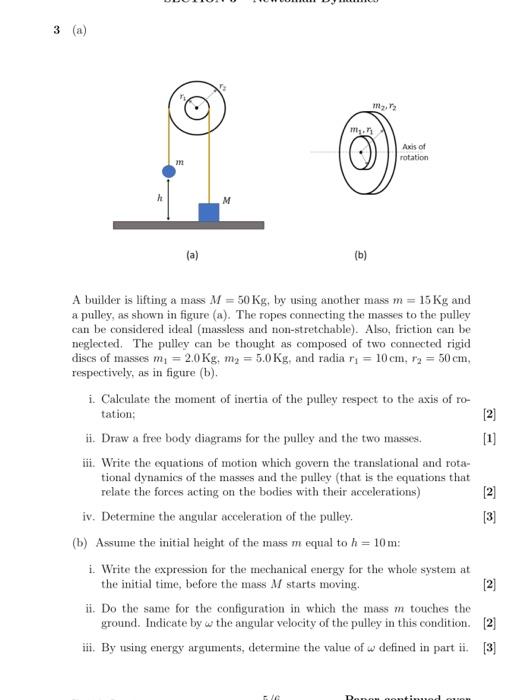
2,2 Axis of rotation m (a) (b) A builder is lifting a mass M = 50 Kg, by using another mass m = 15 Kg and a pulley, as s
Posted: Mon May 09, 2022 1:40 pm
by answerhappygod
- 2 2 Axis Of Rotation M A B A Builder Is Lifting A Mass M 50 Kg By Using Another Mass M 15 Kg And A Pulley As S 1 (46.4 KiB) Viewed 21 times
2,2 Axis of rotation m (a) (b) A builder is lifting a mass M = 50 Kg, by using another mass m = 15 Kg and a pulley, as shown in figure (a). The ropes connecting the masses to the pulley can be considered ideal (massless and non-stretchable). Also, friction can be neglected. The pulley can be thought as composed of two connected rigid discs of masses m = 2.0 Kg, my 5.0 Kg, and radia rı = 10cm, 12 = 50 cm, respectively, as in figure (b). i. Calculate the moment of inertia of the pulley respect to the axis of ro- tation: [2] ii. Draw a free body diagrams for the pulley and the two masses. [1] iii. Write the equations of motion which govern the translational and rota- tional dynamics of the masses and the pulley (that is the equations that relate the forces acting on the bodies with their accelerations) [2] iv. Determine the angular acceleration of the pulley. [3] (b) Assume the initial height of the mass m equal to h=10m: i. Write the expression for the mechanical energy for the whole system at the initial time, before the mass M starts moving [2] ii. Do the same for the configuration in which the mass m touches the ground. Indicate by w the angular velocity of the pulley in this condition. [2] iii. By using energy arguments, determine the value of w defined in part ii. [3] ] Ponnu contimind munn