- A Show That The Mean Pressure On The Wall Perpendicular To The C Direction Is Given By 72 2 P1 Nr Er A 3 Mv Le 1 (155.56 KiB) Viewed 46 times
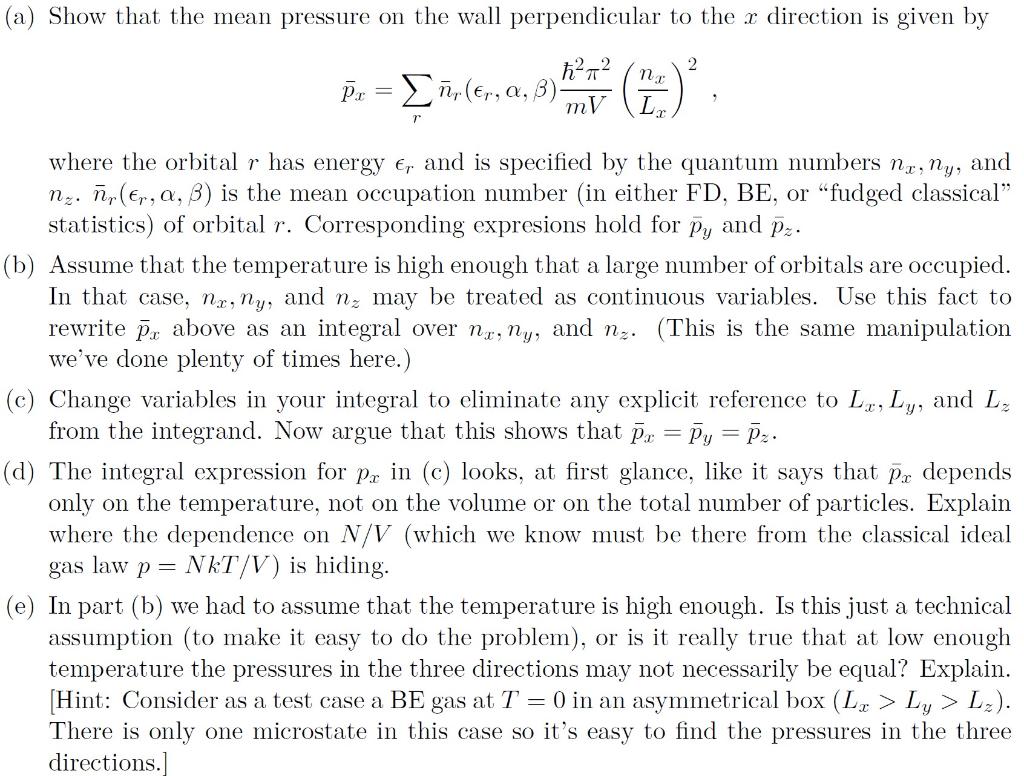
(a) Show that the mean pressure on the wall perpendicular to the c direction is given by 72 2 P1 = ñr (er, a, 3) mV LE (二) and where the orbital r has energy €r and is specified by the quantum numbers Nz, Ny, and nz. ñ, (er, a, 3) is the mean occupation number (in either FD, BE, or “fudged classical”. statistics) of orbital r. Corresponding expresions hold for Py Pz. (b) Assume that the temperature is high enough that a large number of orbitals are occupied. In that case, Ne, ny, and n, may be treated as continuous variables. Use this fact to rewrite px above as an integral over nu, ny, and nz. (This is the same manipulation we've done plenty of times here.) (c) Change variables in your integral to eliminate any explicit reference to Ly, Ly, and L, from the integrand. Now argue that this shows that = Py = Dz. (d) The integral expression for Pr in (c) looks, at first glance, like it says that pe depends only on the temperature, not on the volume or on the total number of particles. Explain where the dependence on N/V (which we know must be there from the classical ideal p= - NKT/V) is hiding. (e) In part (b) we had to assume that the temperature is high enough. Is this just a technical assumption (to make it easy to do the problem), or is it really true that at low enough temperature the pressures in the three directions may not necessarily be equal? Explain. [Hint: Consider as a test case a BE gas at T = 0 in an asymmetrical box (Lx > Ly > L2). There is only one microstate in this case so it's easy to find the pressures in the three directions. gas law