Page 1 of 1
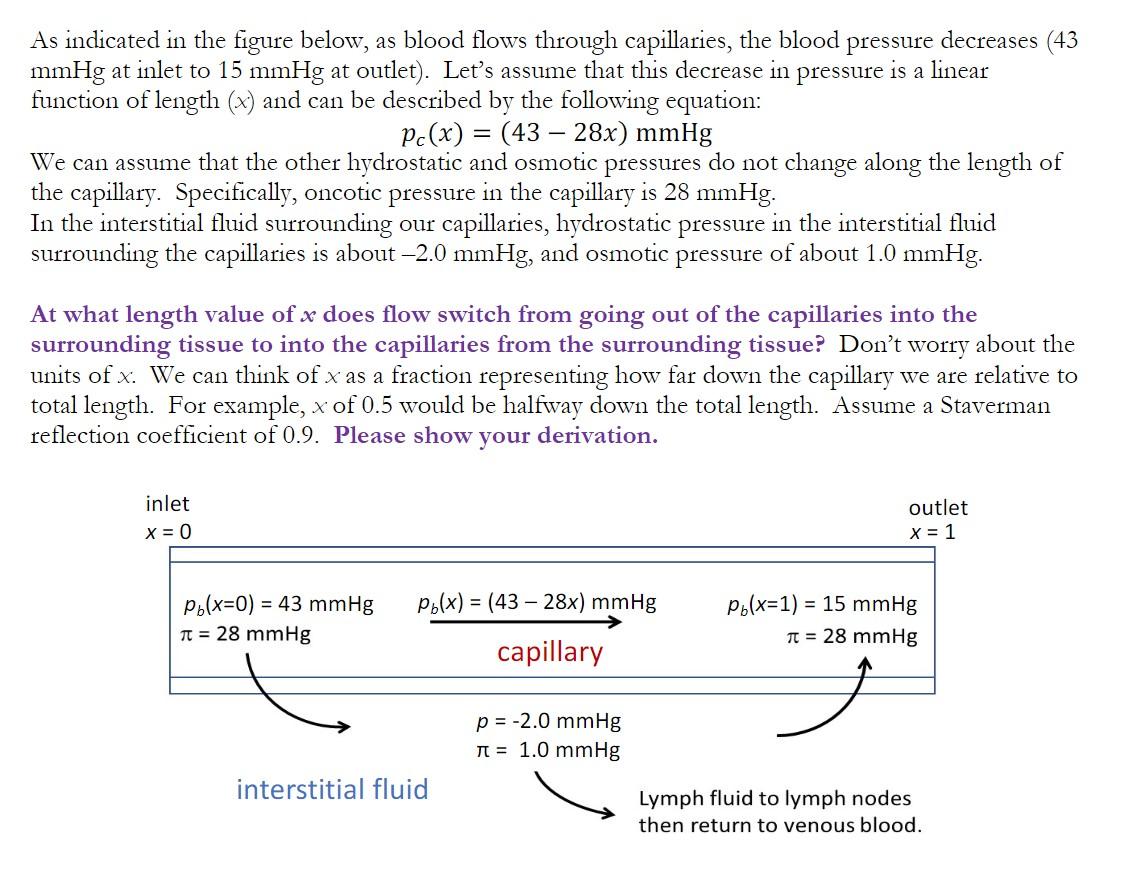
As indicated in the figure below, as blood flows through capillaries, the blood pressure decreases (43 mmHg at inlet to
Posted: Mon May 09, 2022 1:35 pm
by answerhappygod
- As Indicated In The Figure Below As Blood Flows Through Capillaries The Blood Pressure Decreases 43 Mmhg At Inlet To 1 (145.88 KiB) Viewed 24 times
As indicated in the figure below, as blood flows through capillaries, the blood pressure decreases (43 mmHg at inlet to 15 mmHg at outlet). Let's assume that this decrease in pressure is a linear function of length (x) and can be described by the following equation: pc(x) = (43 – 28x) mmHg We can assume that the other hydrostatic and osmotic pressures do not change along the length of the capillary. Specifically, oncotic pressure in the capillary is 28 mmHg. In the interstitial fluid surrounding our capillaries, hydrostatic pressure in the interstitial fluid surrounding the capillaries is about –2.0 mmHg, and osmotic pressure of about 1.0 mmHg. At what length value of x does flow switch from going out of the capillaries into the surrounding tissue to into the capillaries from the surrounding tissue? Don't worry about the units of x. We can think of x as a fraction representing how far down the capillary we are relative to total length. For example, x of 0.5 would be halfway down the total length. Assume a Staverman reflection coefficient of 0.9. Please show your derivation. inlet x = 0 outlet x = 1 po(x) = (43 - 28x) mmHg po(x=0) = 43 mmHg T = 28 mmHg pblx=1) = 15 mmHg 1 = 28 mmHg capillary p = -2.0 mmHg n = 1.0 mmHg interstitial fluid Lymph fluid to lymph nodes then return to venous blood.