Page 1 of 1
12. Consider v= E(r) in spherical coordinates. (a) Compute V xv in spherical coordinates. [3 points) (b) Now, compute v.
Posted: Mon May 09, 2022 1:32 pm
by answerhappygod
- 12 Consider V E R In Spherical Coordinates A Compute V Xv In Spherical Coordinates 3 Points B Now Compute V 1 (63.08 KiB) Viewed 22 times
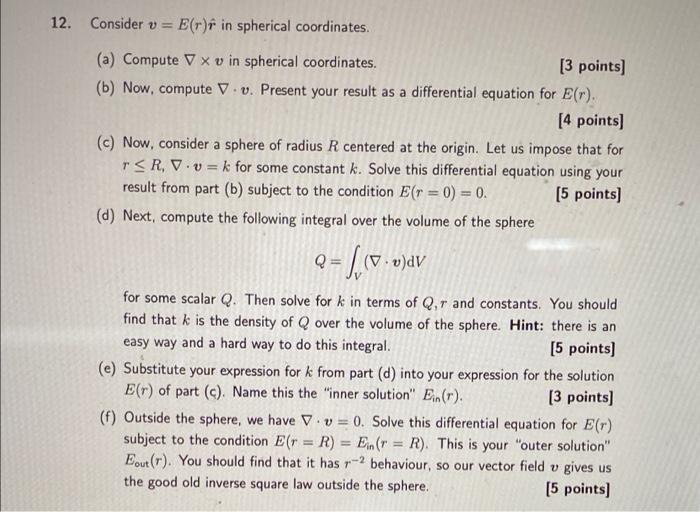
12. Consider v= E(r) in spherical coordinates. (a) Compute V xv in spherical coordinates. [3 points) (b) Now, compute v.v. Present your result as a differential equation for E(r). [4 points) ©) Now, consider a sphere of radius R centered at the origin. Let us impose that for T<R, V.v=k for some constant k. Solve this differential equation using your result from part (b) subject to the condition E(r = 0) = 0. (5 points) (d) Next, compute the following integral over the volume of the sphere Q = 5.(5.v}av for some scalar Q. Then solve for k in terms of Q,r and constants. You should find that k is the density of Q over the volume of the sphere. Hint: there is an easy way and a hard way to do this integral. [5 points) (e) Substitute your expression for k from part (d) into your expression for the solution E(r) of part (c) Name this the "inner solution" Enr). [3 points) (f) Outside the sphere, we have V .v = 0. Solve this differential equation for E(r) subject to the condition E(r = R) = En (r = R). This is your "outer solution" Eout (r). You should find that it has r-2 behaviour, so our vector field v gives us the good old inverse square law outside the sphere. [5 points)