- 1 Relativistic Wave Equations The Time Dependent Schrodinger Equation For A Free Particle Is Ha Iha R T Vour T 1 1 (184.71 KiB) Viewed 28 times
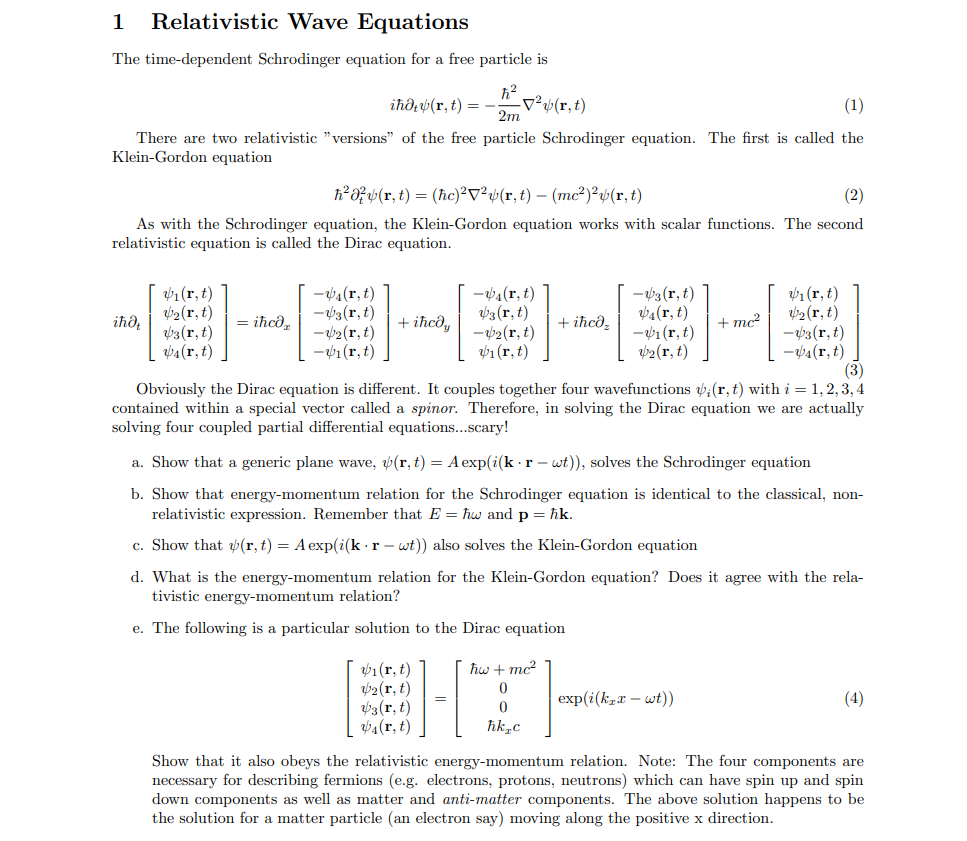
1 Relativistic Wave Equations The time-dependent Schrodinger equation for a free particle is ha iha (r, t) = vºur,t) (1) 2m There are two relativistic "versions" of the free particle Schrodinger equation. The first is called the Klein-Gordon equation hv(r, t) = (hc)2V2y(r, t) - (mc)(r,t) (2) As with the Schrodinger equation, the Klein-Gordon equation works with scalar functions. The second relativistic equation is called the Dirac equation. V1(r, t) -V4r, t) -04r, t) -03 (r, t) u1r, t) U2r, t) iha = ihcă, -43(r, t) + iħca 23(r, t) 14r, t) + ihca. + me? U2r, t) 03(r, t) -02(r, t) - U2(r, t) -Uir,t) -U3r, t) 04r, t) -01r, t) Vir, t) 02(r, t) -04r, t) (3) Obviously the Dirac equation is different. It couples together four wavefunctions Vir, t) with i = 1, 2, 3, 4 contained within a special vector called a spinor. Therefore, in solving the Dirac equation we are actually solving four coupled partial differential equations...scary! a. Show that a generic plane wave, vír, t) = A exp(i(kr - wt)), solves the Schro equation b. Show that energy-momentum relation for the Schrodinger equation is identical to the classical, non- relativistic expression. Remember that E= hw and p = pk. c. Show that var, t) = A exp(i(kr - wt)) also solves the Klein-Gordon equation d. What is the energy-momentum relation for the Klein-Gordon equation? Does it agree with the rela- tivistic energy-momentum relation? e. The following is a particular solution to the Dirac equation vir, t) U2(r, t) Us(r, t) (r, t) 1-1 hw + mc? 0 0 hk,c exp(i(kit - wt)) (4) Show that it also obeys the relativistic energy-momentum relation. Note: The four components are necessary for describing fermions (e.g. electrons, protons, neutrons) which can have spin up and spin down components as well as matter and anti-matter components. The above solution happens to be the solution for a matter particle (an electron say) moving along the positive x direction. x