Page 1 of 1
Question 3 Betty runs a toy store. Each toy costs Betty $4 and sells for $10 (so the gross profit per unit sold is $6).
Posted: Mon May 09, 2022 12:52 pm
by answerhappygod
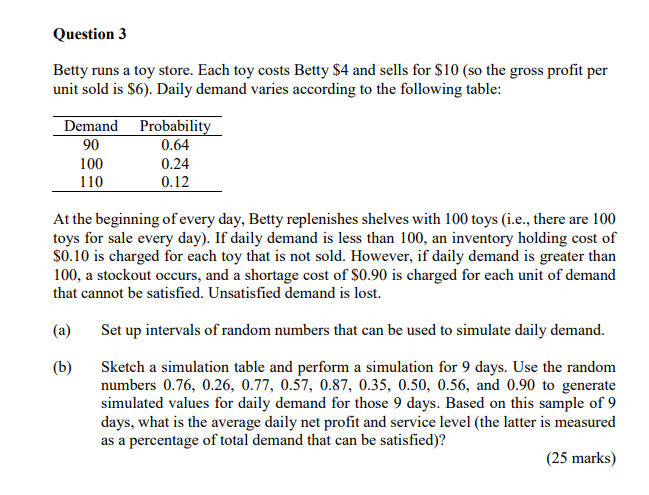
- Question 3 Betty Runs A Toy Store Each Toy Costs Betty 4 And Sells For 10 So The Gross Profit Per Unit Sold Is 6 1 (100.35 KiB) Viewed 22 times
Question 3 Betty runs a toy store. Each toy costs Betty $4 and sells for $10 (so the gross profit per unit sold is $6). Daily demand varies according to the following table: Demand Probability 0.64 100 0.24 110 0.12 90 At the beginning of every day, Betty replenishes shelves with 100 toys (i.e., there are 100 toys for sale every day). If daily demand is less than 100, an inventory holding cost of $0.10 is charged for each toy that is not sold. However, if daily demand is greater than 100, a stockout occurs, and a shortage cost of $0.90 is charged for each unit of demand that cannot be satisfied. Unsatisfied demand is lost. (a) Set up intervals of random numbers that can be used to simulate daily demand. Sketch a simulation table and perform a simulation for 9 days. Use the random numbers 0.76, 0.26, 0.77, 0.57, 0.87, 0.35, 0.50, 0.56, and 0.90 to generate simulated values for daily demand for those 9 days. Based on this sample of 9 days, what is the average daily net profit and service level (the latter is measured as a percentage of total demand that can be satisfied)? (25 marks) (6)