Page 1 of 1
Gmother G father mother G father mother father H. mother Hfather H. mother H father Н. mother H father G child G child G
Posted: Mon May 09, 2022 12:40 pm
by answerhappygod
- 1 (196.53 KiB) Viewed 21 times
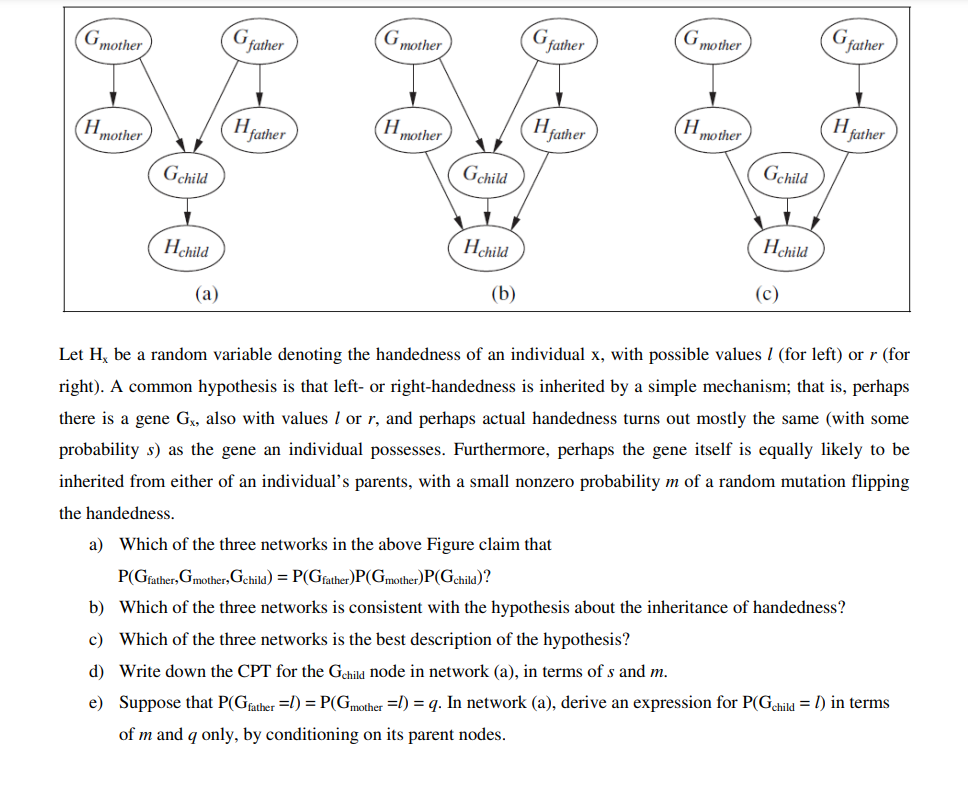
Gmother G father mother G father mother father H. mother Hfather H. mother H father Н. mother H father G child G child Gchild Hchild Hchild Hchild (a) (b) (c) Let H, be a random variable denoting the handedness of an individual x, with possible values 1 (for left) or r (for right). A common hypothesis is that left- or right-handedness is inherited by a simple mechanism; that is, perhaps there is a gene Gx, also with values l or r, and perhaps actual handedness turns out mostly the same (with some probability s) as the gene an individual possesses. Furthermore, perhaps the gene itself is equally likely to be inherited from either of an individual's parents, with a small nonzero probability m of a random mutation flipping the handedness. a) Which of the three networks in the above Figure claim that P(Gfather, mother, Gchild) = P(Gfather)P(Gmother) P(child)? b) Which of the three networks is consistent with the hypothesis about the inheritance of handedness? c) Which of the three networks is the best description of the hypothesis? d) Write down the CPT for the Gchild node in network (a), in terms of sand m. e) Suppose that P(Gfather =1) = P(Gmother =1) = q. In network (a), derive an expression for P(Gehild = 1) in terms of m and q only, by conditioning on its parent nodes.